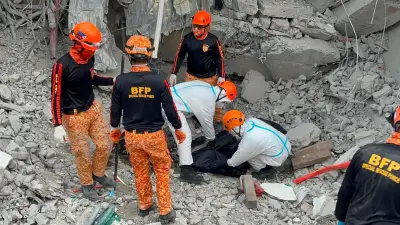
According to the latest report from the Office of Civil Defense (OCD), 37 lives have been lost, 488 injured, and four remain missing after a magnitude 7.8 earthquake struck Mindanao on Monday, June 8, 2026, coinciding with the first day of classes.
Most of the victims were buried by landslides and collapsed structures. Despite this tragic event, the government announced a major relief: no area was isolated or cut off despite damaged roads. The Department of Public Works and Highways (DPWH) has deployed equipment and machinery for road clearing.
The General Santos International Airport remains closed to commercial operations and is currently limited to military flights. Over 3,600 personnel from various government agencies were immediately deployed, while an additional 2,300 forces from the Armed Forces of the Philippines (AFP), Philippine National Police (PNP), Bureau of Fire Protection (BFP), and Philippine Coast Guard (PCG) are on standby for further mobilization.

To sustain relief efforts, a logistics hub was established in Davao City to send personnel and supplies via helicopter to General Santos City and adjacent affected areas. This demonstrates the importance of rapid government coordination during crises.
One notable achievement is that no student died in the earthquake on the opening day of classes, thanks to the Department of Education (DepEd) and OCD. Although infrastructure damage was extensive—8,208 classes suspended and over 1,200 schools damaged in Regions 11 and 12—the zero student fatality shows that earthquake drills and preparedness programs in schools were effective.
While the government assures sufficient funds for aid—such as P1 million worth of family food packs from DSWD—the greater challenge is rebuilding damaged homes. According to OCD Deputy Administrator Bernardo Rafaelito Alejandro IV, 2,505 houses were damaged, including 460 totally destroyed and 2,045 partially damaged.