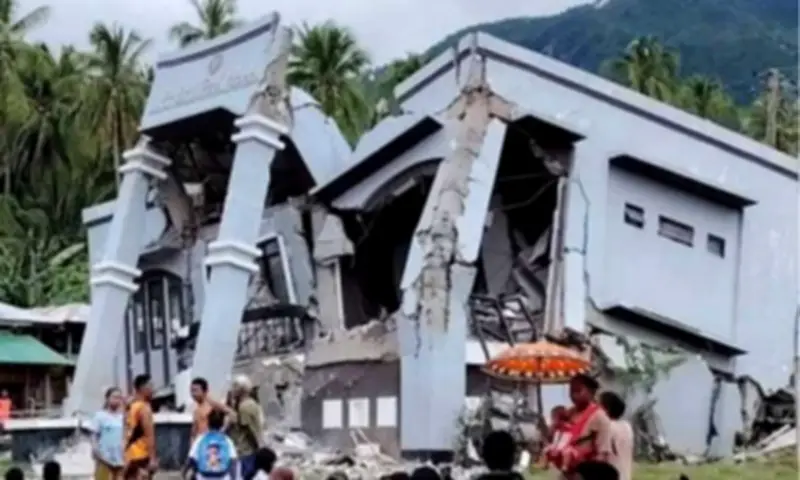
Mindanao Earthquake Death Toll Rises to 37
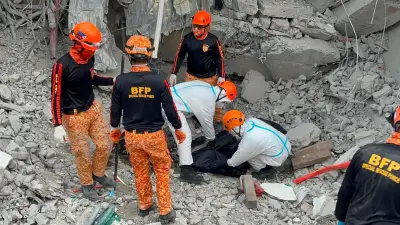
The death toll from the magnitude 7.8 earthquake that struck Mindanao on Monday, June 8, 2026, has risen to 37 as of Tuesday, June 9, according to the Office of Civil Defense (OCD). The National Disaster Risk Reduction and Management Council (NDRRMC) reported four fatalities in Region 11 (Davao Region) and 33 in Region 12 (Soccsksargen).
OCD Deputy Spokesperson Diego Mariano detailed that in Region 12, Sarangani recorded 18 deaths, General Santos City 12, and South Cotabato three. The earthquake prompted authorities to place General Santos City under a state of calamity after damaging structures, vital installations, bridges, and roads.
The earthquake struck at 7:37 a.m. on Monday, located approximately 32 kilometers south-southwest of Maasim, Sarangani, at a depth of 33 kilometers. The tremor was felt across large parts of Mindanao, triggering damage assessments in affected areas.

Phivolcs: Cotabato Trench Generated the Quake
Philippine Institute of Volcanology and Seismology (Phivolcs) Visayas Cluster Monitoring Center Director Robinson Jorgio clarified that the earthquake was generated by the Cotabato Trench and has no direct link to active fault systems in Cebu or the rest of Central Visayas.
“This is generated by the Cotabato Trench. A few years ago there was a magnitude 6.8 within that area. Early this year we recorded swarms related to the Cotabato Trench,” Jorgio said during a media forum in Cebu City. He added that the continuous earthquakes of lesser magnitude earlier this year were foreshocks related to the magnitude 7.8 event, as they originated from the same source.
Jorgio explained that earthquake swarms are a series of smaller earthquakes occurring in the same area over time, while post-major quake events are classified as aftershocks. He emphasized that the country’s trenches and fault systems result from tectonic plate movements compressing the Philippine archipelago.
“Our trenches and fault systems are products of major plate tectonics which are pushing or squeezing the Philippine archipelago. The weakest portion of the system will rupture first and create an earthquake,” Jorgio said. However, he stressed that the Cotabato Trench is far from fault systems in Central Visayas, particularly in Cebu.
Renewed Discussion on the “Big One”
The Mindanao quake has revived public discussion about the “Big One,” a term for a potential major earthquake that could strike heavily populated areas. This typically refers to a predicted magnitude 7.2 earthquake along the 100-kilometer West Valley Fault, which could cause widespread destruction in Metro Manila.
In Cebu, Jorgio noted that potentially active faults could generate a major earthquake, with a possible magnitude of 7.2 to 7.5 and Intensity 8 ground shaking across the island. However, Phivolcs stated that the timing of such an event remains uncertain, and the agency continues to monitor ground movements.
Strengthening Earthquake Monitoring in Visayas
Phivolcs maintains continuous monitoring of active faults in the region. A temporary seismic system remains operational in northern Cebu, particularly in Bogo City, where a magnitude 6.9 earthquake struck on September 30, 2025. “In Bogo, our monitoring remains continuous. We still have augmented temporary seismic stations there so we can obtain complete data,” Jorgio said.
Jorgio acknowledged the challenge of monitoring all active faults simultaneously due to limited instruments. “Here in Cebu, we monitor all faults within the Visayas, but we cannot monitor all of them at the same time because the number of instruments we can deploy is limited,” he said.
To address this, Phivolcs plans to install additional seismographs, accelerometers, and GPS-based ground deformation monitoring equipment in Cebu and Bohol before the end of 2026.
Public Preparedness Urged
Jorgio reminded the public that earthquake preparedness is crucial regardless of where a major earthquake occurs. He advised residents to assess the structural condition of the buildings they occupy and determine whether these can withstand strong ground shaking.

“If we know that our building is structurally sound, our first reaction should be to protect ourselves from falling debris. We should duck, cover, and hold,” Jorgio said. He also urged local governments to continue hazard assessments and planning, noting that Phivolcs has been working with officials in Cebu and Mandaue City to improve disaster preparedness through exposure and vulnerability mapping.
Phivolcs emphasized that continuous monitoring and public preparedness remain essential as active faults and trenches across the country continue to generate earthquakes.