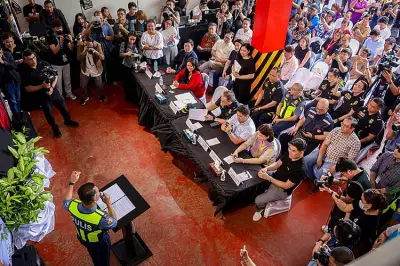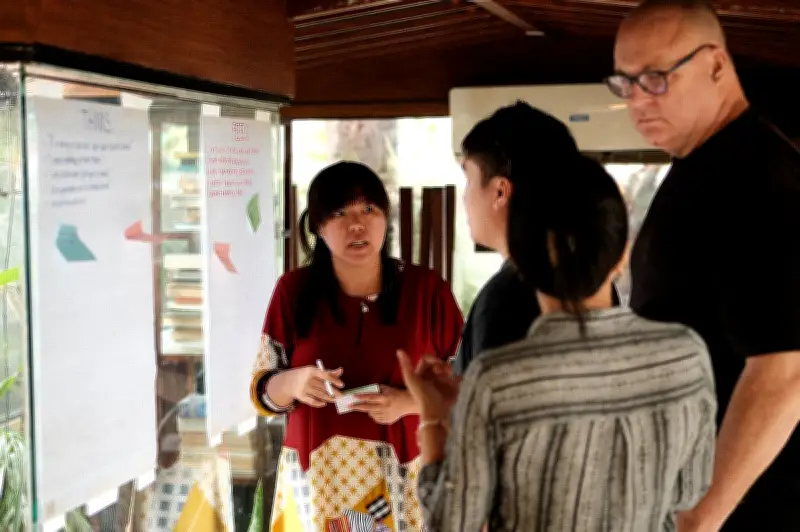
On April 25, 2026, at Glass House Davao, I found myself in a room that felt both experimental and hopeful, like the early pages of a story still deciding what it wanted to become.
Our speaker, Cris Vinson, did not begin with flashy promises about artificial intelligence. Instead, he told us something more human. He once ran a business with around thirty people under his wing. It was the kind of success many of us chase, built on hard work, long hours, and a relentless push forward. But success, as he shared, has its shadows. Last year, a medical emergency forced him to pause and ask a question many of us avoid: Why am I doing all this?
It was not a boardroom that slowed him down, but life itself. And sometimes, that is the only thing powerful enough to do it. He suffered a heart attack. Encouraged by his girlfriend to rest and recover here in Davao, Cris faced a dilemma familiar to many driven individuals: how do you slow down when your instinct is to keep building? His answer was not to stop working, but to work differently.

Enter AI
Rather than diving back into the same high-pressure setup, Cris began experimenting. Smaller steps. Lighter systems. He leveraged AI not as a replacement for effort, but as a partner in it, testing whether Davao might be fertile ground for something new. That seed took the form of AI Business Hour, an intimate gathering of curious minds trying to understand what this technology could actually do for them.
And like any real experiment, it did not go perfectly. In fact, AI itself gave us our first lesson in humility. Cris’s AI secretary “Alice” accidentally sent participants to the wrong venue — Glass House Toril instead of our actual location, Glass House in Rizal. Out of thirty who signed up, only twelve made it. A smaller crowd, yes, but perhaps the right one.
What Followed Was Not a Lecture, but a Conversation
Around half of us came from traditional brick-and-mortar businesses, while the rest were exploring or already running online ventures. Different worlds, same questions: How do we adapt? Where do we even begin? Cris guided us through possibilities rather than prescriptions. AI, he explained, is not foolproof — and our little location mishap proved that — but it is powerful when used with intention. Much of its strength lies in automation and marketing: simplifying repetitive tasks, reaching the right audience, and freeing up time for what truly matters.
As a teacher, artist, and writer, I could not help but see AI not as a threat, but as a tool, much like a paintbrush or a pen. It does not replace the creator. It simply extends what we can do, if we learn how to use it well. I keep telling everyone that AI is such an umbrella term, but at the end of the day, AI is a tool.
The Real Lesson: Building Sustainably
What struck me most was not the technology itself, but the shift in mindset. We, as Dabawenyos, have to build sustainably. Thoughtfully. Humanely. And maybe that is the real lesson from that afternoon in Davao. We do not have to run ourselves into the ground to build something meaningful. Sometimes, we just need to pause, reassess, and plant our next seed more wisely. Even if, along the way, AI accidentally sends us to the wrong place. Because sometimes, the right conversation still finds you.