Stories hold power. When memories of a difficult past are translated into closure, the result is a visceral art exhibition that explores the power dynamics between oppressors and victims — and how we become our own gods playing with power.
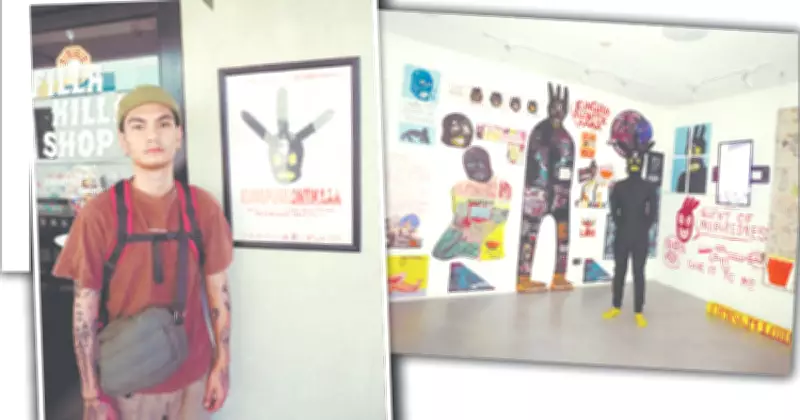
Dominic Matthew Ricardo, known in the creative scene as “KOMPOZTIKA” and “DMR,” recently opened his solo thesis exhibition for UP Cebu Fine Arts, “KUNGPUSILONTIKAAA,” at Galerie Inatù at Atua Midtown. The 24-year-old artist is active in the local street art and underground punk scene of Cebu City, with work heavily influenced by neo-expressionism and lowbrow art.
The Impulse of Memory
The exhibit is rooted in a personal experience from 2017. At the time, Dominic was a high school student living through the peak of the Philippine Drug War. He recalls a random afternoon after school when state forces — masked men — invaded his home, extorted his family and seized their belongings.

During the encounter, one of the men asked a question that would haunt Dominic for years: “Kung pusilon tika? Maunsa man ka?” (If I shoot you, what will happen to you?).
“I was a teenager at that time, so I grew up out of impulse,” Dominic said. “Ever since then, I always had that fear in me — what if they come back?”
Subconscious Shadows
The years following the event were defined by hyper-vigilance and paranoia. Dominic found that he could no longer enjoy “normal” days; the trauma had settled into his subconscious. It began to bleed into his art unintentionally. Whenever he doodled, he found himself drawing masked men and god-like figures.
“Since I can’t stop thinking about it, why not make it my thesis?” he explained. “I also made it for closure, so I can finally move on.”
From Poem to Painting
Dominic’s creative process is raw and unconventional. He avoids traditional sketches or drafts. Instead, he begins by writing poems on paperwork — intimate verses intended only for himself. These poems then serve as the sole reference for his paintings.
The production of the exhibit was an intense, “unhealthy” month for the artist. Dealing with these “noisy memories” was a weight he felt he couldn’t carry while sober, often requiring a drink to face the specific emotions needed to finish the pieces.
There is a distinct duality in his work. In his paper-based pieces, he maintains a sense of humor, incorporating memes and pop-culture references. However, when he transitions to canvas, the tone shifts toward the intimate, the melancholic and the deeply emotional.
The Manifestation of ‘JOD’
At the center of the exhibition is JOD, a character that serves as a manifestation of the trauma. Depicted as a black figure holding a gun, JOD represents state forces and the inherent violence of a god complex.
“I call him JOD because he wants to become a god, but he can’t become one,” Dominic said.
This leads to his concept of “Situational Gods.” He explains that during the raid, the state forces were his “gods” because they held the power of life and death. However, the power shifts when the victim becomes the creator. “It becomes a ‘Situational God’ when power is passed from the oppressor to the victim — because now I write about them, I create art about them, and I talk about them.”
Shifting Dynamics
Dom offers a striking analogy for this shift: a human acts as a god when they use insect spray to kill a cockroach, but when cockroaches infest a home, they become the ones in control. Power is never static; it is always shifting.
Closing with a moving message for his fellow creators, Dominic emphasizes the necessity of vulnerability.
“Just be honest in your work,” he urged. “Just be honest with what you’re trying to portray in your trauma. There are a lot of people experiencing it; it’s a collective experience. Just expressing yourself visually or through writing — especially honestly — it really helps.”

Lastly, “KUNGPUSILON-TIKAAA” is proof of reclaiming one’s narrative. By externalizing the “masked men” of his youth into the figure of JOD, Dominic is no longer the teenager facing a threat; he is the artist defining his world on his own terms — proving that while trauma is a collective weight, the act of honest expression is the most powerful path to healing.