Dr. Lita A. Bacalla emphasized the importance of studying morphology to understand language structure, particularly in Tagalog and Cebuano. Both languages belong to the Austronesian family, so they share similarities in word formation. However, they have diverged over time due to geographical conditions and cultural influences.
Previous Studies on Morphology
Past research indicates that Austronesian languages, including Tagalog and Cebuano, have rich affixation systems. Theories on language change over time, common origin, and variation due to location and speaker usage were discussed.
Systematic Comparison Using Tables
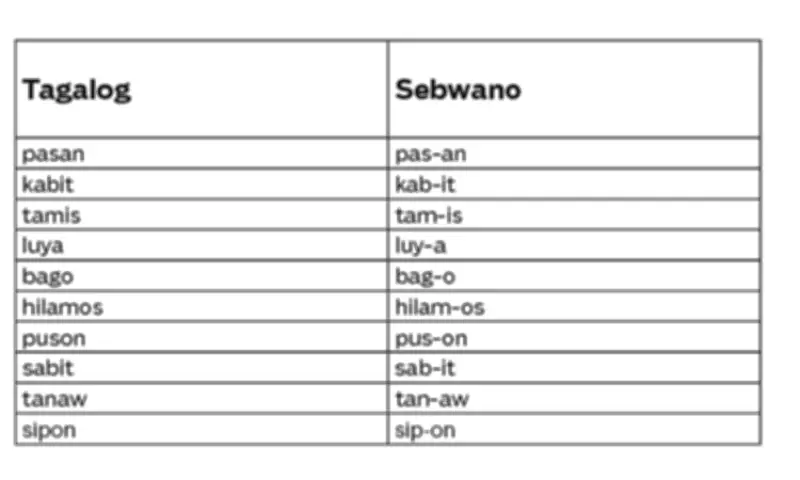
Tables were used to systematically present similarities and differences between the two languages. This organized approach clarified study results.

Some words have identical spelling and meaning in Tagalog and Cebuano but differ in pronunciation. For instance, the Tagalog word bago (meaning new) becomes bag-o in Cebuano, with a glottal stop between vowels. Similarly, luya becomes luy-a. Tagalog pronunciation is softer, while Cebuano is harder.
A key rule in Cebuano is the use of a hyphen to separate vowels and consonants, altering pronunciation. This shows that even with shared roots, pronunciation differs due to geographical factors.
According to Wardhaugh (2010), language variation arises from community usage. Differences are inevitable even within the same province, influenced by migration and settlement patterns.
In language analysis, geography is a basic consideration. Even when the same language is used, its application varies depending on culture, customs, and societal norms.
Overall, the divergence between Tagalog and Cebuano stems from language development in different contexts. Cebuano is closer to Tagalog in some aspects. No language is superior or inferior; each has unique qualities and purposes for daily communication.