Today marks 37 years since the massacre of 39 children, women, and men at Sitio Rano, Barangay Binaton, Digos, Davao del Sur. The local United Church of Christ in the Philippines (UCCP) had 73 members, new converts from the Bagobo-Tagabawa tribe. Many had gathered for Sunday morning worship when 70 cadres of the New People’s Army (NPA) opened fire. Seeking more victims, they strafed nearby homes where children and women had sought refuge.
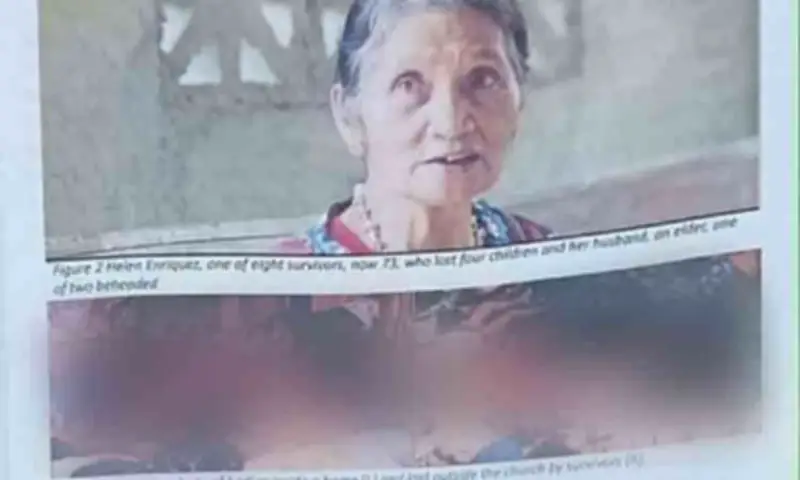
Screams of children and pleas for mercy went unheeded. Among the 22 child victims were toddlers, a two-month-old baby, and a mother heavy with child. Another 17, mostly mothers and fathers, also lost their lives. Photographs of the massacre are heartbreaking: bodies bathed in blood, some with slit throats, others with bayonet wounds. One elder was killed along with four of his children. He was one of two men beheaded. Only his wife, Helen Enriquez, now 73, and a four-year-old daughter survived.
Survivors' Accounts and NPA's Turn to Violence
After the three-hour carnage, the NPA cadres returned to the church, laughing and singing revolutionary songs. In a videotape three decades later, the elder’s widow said that relations started out friendly with the NPA who called themselves “soldiers of the poor” (sundalo sa kabus). But then, another survivor added, the NPA turned abusive, demanding more rice and more money. One would be killed for a small mistake. Another said, if they were soldiers of the poor, why did they kill the poor? Also, they could not accept the Communist concept of God as a “figment of the imagination” and the belief that religion and revolution were incompatible. Saying No to the revolutionary tax, the community joined Ituman (The Black Ones), a vigilante group, in self-defense. They also turned to government which angered the NPA and triggered the bloodbath.

Institutional Responses and Lingering Gaps
The UCCP national leadership conducted a probe and said the incident “raised grave doubts” about the NPA’s efforts “toward social transformation based on justice”. No denunciation from the national office for the murder of fellow UCCP members, only a lukewarm reprimand to the NPA for unprecedented brutality. The NPA apologized for the massacre as reported by the Associated Press soon after the massacre.
A Rano Memorial marker honors the memory of massacre victims in Rimpong Tribal Village in Barangay Binaton, part of the Hall of Peace (Bale Kasunayan) which portrays the life, rebirth, and transformation of the Bagobo-Tagabawa tribe. In yearly celebrations, clan elders speak of a yearning for peace and harmony, and a vow to end the violence that shatters communities and kills babies.
Yet government has also fallen short. At the 2020 commemoration, one elder said the promise of roads and public transport remained empty three decades after the massacre. Subsequently, livelihood assistance has been provided but much more needs to be done. An over-reliance on the Anti-Terror Act cannot substitute for comprehensive development programs among long-neglected indigenous peoples. Most disturbing is the fact that Commander Bensar, who led the attack, surrendered to government in the late 1990s. He and his comrades who sought amnesty apparently have not been prosecuted. Where is justice for the 39 victims?
Lessons for the UCCP and the Path Forward
What does the Rano massacre signify for us, local UCCP churches, 37 years after the fact? Firstly, the Rano massacre warns us to beware of false prophets. In 1989, members of the Bagobo-Tagabawa tribe became friends with the NPA who claimed to be “soldiers of the poor”. Any group which glibly promises heaven on earth must be viewed with healthy skepticism. Today our national and conference leaders hold high the banner of corporatism, turning UCCP properties, schools, and hospitals into commercial enterprises, with profits supposedly giving better pay and comfortable pensions to pastors and church workers. But have they?

Secondly, the Rano massacre calls on us to disavow violence as the answer to social problems. On a bright Sunday morning, 39 Rano worshippers lost their lives to armed violence, most of them innocent children. The use of arms turns young men into blood-thirsty monsters. Ask UCCP former rebels, lay, and pastors who have now returned to the fold. For us, today, violence takes many forms: the summary expulsion of outspoken pastors, the padlocking of defiant local churches, the denial of hospital services and medical support to bishops out of favor with the national leadership, the withholding of church assignments from pastors who reject left ideology and corporatism that have replaced the faith. Violence also comes with a forked tongue, the sweet, seductive words that help rewrite our Constitution and Bylaws, that erode our Basis of Union, that turn our democratic polity into one lorded over by bishops, that redirect theology from a Christ-centered gospel to one propelled by human enterprise, that lead seminary students astray to an alien ideology. To achieve enduring peace, we must follow the path of peace, no short-cuts.
Thirdly, the Rano massacre calls on us to repent of our sins of commission and omission: for lacking empathy with our indigenous brothers and sisters and thus only belatedly identifying with their pain and suffering; for simply voting with the majority at conferences and assemblies for convenience; for holding our tongue because speaking out will invite stigma and isolation; for being blind to injustice within our church and beyond our gates.
God Creator, Jesus Redeemer, Holy Spirit Sustainer, we say MEA CULPA. For an event nearly four decades old whose pain we have only begun to feel, and whose meaning we have yet to fully comprehend; and for our sins, individual and collective, that allow the Rano violence of false prophets and armed short-cuts to creep into UCCP polity and theology, threatening UCCP’s very existence. Triune God, you heal the wounds of a local church in Davao that stared death in the face 37 years ago today. They have not turned bitter, they have kept the faith, believing—against all odds—in the gospel promise of life abundant. Justice has largely eluded the massacre victims. But through decades of despair and disappointment, they have kept hope alive.
We mourn in solidarity with our Bagobo Tagabawa sisters and brothers, knowing that where they fall, we also fall; when they rise, we also rise. Help us draw from their wisdom and resilience, affirming that truth, justice, and peace will ultimately prevail. Refresh our souls and heal our broken UCCP, for love—not hate, not violence—is the last word. This, we pray, in Christ’s name, and may God bless us all. – UCCP Evangelical Fellowship