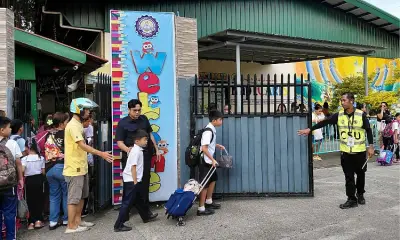
Recent incidents of school violence involving minors have led to renewed calls for stricter gun control and a lower age of criminal responsibility. These measures may help in some way, but they do not reach the root of the problem. If we only focus on laws and punishments, we ignore a deeper issue: the weakening of parental responsibility and discipline at home, according to SunStar columnist Giel Eduard Acot Orillosa.
Values Before Laws
Every serious social problem starts as a problem of values before it becomes a problem of law. Schools may install security systems and governments may increase penalties, but none of these can replace the role of parents in shaping a child’s character. The home is where children first learn right and wrong. It is where they learn self-control, respect and responsibility. When this foundation is weak, children grow up without clear moral direction.
Today, many children are not growing up in stable and closely guided homes. Some live with only one parent or are raised mainly by relatives. Others spend most of their time alone or with digital devices. In many cases, their strongest influence is no longer a parent but social media, online personalities, or entertainment content that does not always teach good values. We cannot expect stable behavior from children who were never given stable guidance.

Limits of Legal Solutions
Laws can punish wrongdoing, but they cannot teach conscience. Security measures can reduce risk, but they cannot form character. Only parents can do that work consistently, day by day, through presence, example and correction. However, many parents today are afraid to discipline. Some believe discipline is too harsh. Others want to be seen as friends rather than authority figures. Because of this, children sometimes receive unclear messages. They are corrected in words but not in action, or their mistakes are ignored to avoid conflict.
This kind of inconsistency confuses children. Instead of learning accountability, they may grow up believing that their behavior has no real consequences. Over time, this can lead to a weak sense of responsibility. Proper discipline is not about anger or punishment. It is about guidance. It teaches children limits, respect for others and the understanding that freedom always comes with responsibility. Discipline, when done correctly, protects a child’s dignity while shaping their behavior.
Early Habits Shape Society
Children develop habits early in life. What they repeatedly see and experience becomes their standard for what is normal. If they grow up without guidance, those habits become difficult to change later. This is why addressing youth violence cannot rely only on legal or institutional solutions. It must also focus on the family. A child who grows up with clear guidance at home is far less likely to cause harm outside it.
A safer society begins in the home. Parents do not only provide food and shelter; they are also responsible for forming values. When this responsibility is taken seriously, schools become safer, communities become stronger and laws become less burdened. If families fail to teach discipline, society will always struggle to enforce order. And enforcement alone is never enough to build lasting peace.