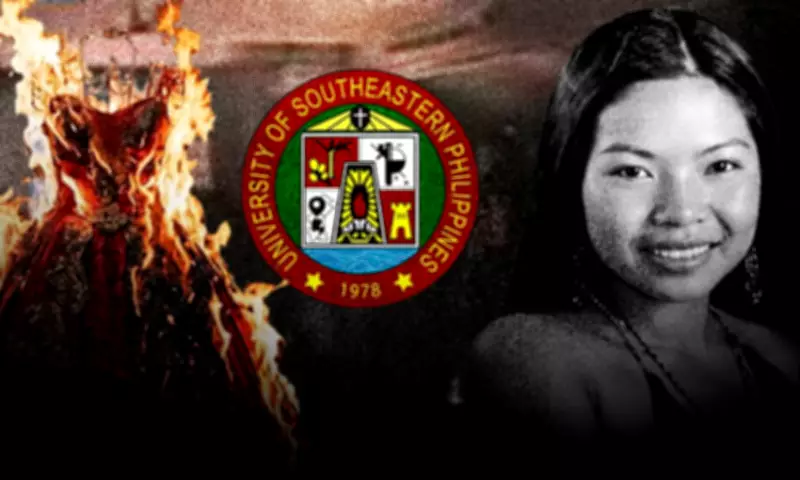
Twenty years after student Cheryl Sarate died in a fire during a university-organized beauty pageant, the University of Southeastern Philippines (USeP) said it respects the recent Supreme Court ruling that found the institution and several university officials liable for negligence and ordered them to pay more than P6 million in damages to Sarate’s family.
In a statement released after the ruling, USeP said the Office of the Solicitor General (OSG), which represents state universities and other government institutions in legal cases, is reviewing the decision.
“As a state university, USeP is represented by the Office of the Solicitor General (OSG), the principal law office and legal defender of government agencies and instrumentalities, including state universities and colleges. The Office of the Solicitor General has received a copy of the Decision and is currently reviewing the matter,” the university said.

The university said its governing authorities, including the Board of Regents, would discuss the ruling in coordination with the OSG and concerned university offices. USeP also asked for public patience as the institution undergoes legal and internal discussions following the ruling.
“The University remains committed to upholding accountability, institutional responsibility, and the welfare of the academic community,” it said.
The statement came after the Supreme Court En Banc issued a landmark ruling holding USeP and several university officials jointly and severally liable for Sarate’s death during a campus beauty pageant in 2006.
In the 46-page decision written by Senior Associate Justice Marvic Leonen, the high court ordered the university and its co-respondents to pay Sarate’s parents P6.45 million in damages, including P300,000 in civil indemnity, P5 million in moral damages, P1 million in exemplary damages, and P150,000 in attorney’s fees.
Court records showed the case stemmed from a beauty pageant organized by the Guild of English Students, a recognized student organization within the university. Organizers staged the event inside the university social hall and built a T-shaped runway decorated with candles placed inside paper bags designed to resemble lanterns. Portions of the venue were dimmed to create a candlelit atmosphere.
Sarate, who portrayed a “snow fairy” during the pageant, wore a costume made of highly flammable materials, including cotton, feathers, plastic cellophane, and tie wire. According to court records, her gown brushed against one of the candles while she posed on the runway, causing the costume to catch fire. The flames quickly spread across her outfit as she tried to extinguish them with her bare hands.
Panic erupted inside the venue as Sarate screamed for help and ran toward the audience area while students rushed to put out the fire. Witnesses later testified that no faculty members actively supervised the event at the time of the incident, except those serving as pageant judges. Court records also showed that emergency response measures appeared inadequate, with the ambulance reportedly arriving about 30 minutes after the fire broke out.
Despite the incident, testimonies presented before the court alleged that organizers resumed the beauty pageant after Sarate was rushed to the hospital. Sarate later died from complications caused by severe burns covering about 80 percent of her body. Medical findings showed she suffered cardiac arrest due to septic shock secondary to extensive flame burns affecting her face, neck, chest, back, and extremities.
Her parents, Antonio and Rosita Sarate, later filed a damages suit against the university and the Guild of English Students, the student organization that organized the pageant. The Regional Trial Court initially ruled that both the university and the student organization were liable, citing inadequate safety precautions and a lack of emergency preparedness during the activity. However, the RTC later modified its ruling and cleared the university of liability, holding only the faculty adviser responsible.

The Sarate family appealed the decision to the Court of Appeals, which reinstated the university’s liability and held that school officials and administrators were collectively negligent under Article 2180 of the Civil Code. The Supreme Court later affirmed the appellate court’s findings, stressing that educational institutions have a heightened duty of care over students participating in school-sanctioned activities.
In its ruling, the tribunal cited the university’s failure to exercise the level of diligence expected from an educational institution, particularly in enforcing safety measures, ensuring emergency preparedness, and providing proper supervision during the event. “During the incident, it was only the students who put out the fire,” the Court noted, highlighting the absence of trained personnel and the apparent failure to activate immediate emergency response protocols.
The Supreme Court also rejected USeP’s argument that the pageant was unauthorized because it allegedly lacked the required permit and violated university policy by being held on a weekday. According to the tribunal, the activity remained connected to the university because a recognized student organization organized it and a faculty adviser supervised it. “The holding of the activity on a date different from the schedule and the fact that it violated the university’s policy of holding activities only on weekends does not make the activity illegal or unauthorized,” the Court said.
The ruling added that the negligence of the organization’s faculty adviser formed part of the “natural, continuous sequence” of events that led to Sarate’s death. The high court also ruled that USeP could be held liable under Articles 2176 and 2180 of the Civil Code as an employer responsible for the negligent acts of its employees acting within the scope of their duties. “There is also collective negligence on the part of the petitioner university, through its administrators and officers-in-charge, when it failed to exercise due diligence in taking safety measures,” the ruling stated.