Schadenfreude in Public Offices: When Bureaucracy Breeds Quiet Pleasure in Others' Misfortune
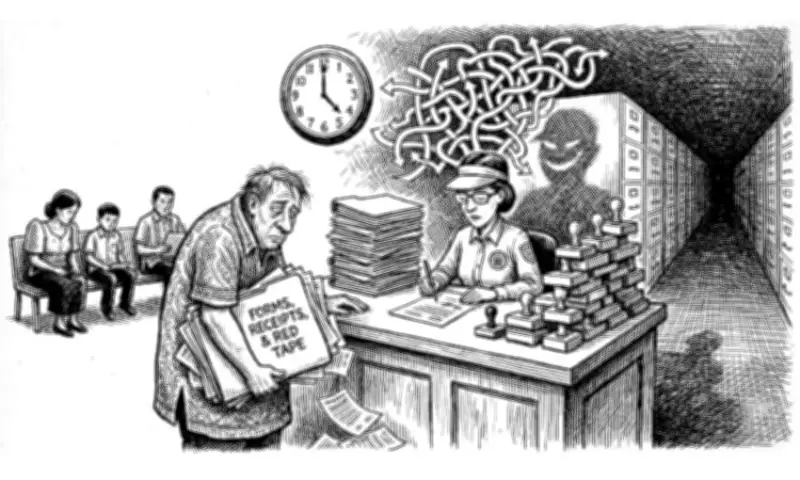
There is a German term that carries more weight than its spelling suggests: schadenfreude. It describes the quiet, often unspoken pleasure derived from witnessing another person's misfortune. While commonly associated with petty rivalries—like a classmate smirking when a competitor stumbles on stage—this phenomenon permeates more mundane settings. It thrives in cramped registrar's offices during enrollment week, at procurement counters where faculty members clutch folders of receipts, and at cashier's windows where mothers from distant barangays await reimbursements to cover their transportation home.
The Human Cost of Bureaucratic Indifference
Schadenfreude is not always expressed through laughter. Sometimes, it manifests as a dismissive shrug, a deliberately slow signature, or the phrase, "Balik na lang po next week," delivered without even glancing up. Many have experienced this sensation—the feeling of being processed rather than served. Years ago, I personally waited nearly three months for a reimbursement that amounted to less than a thousand pesos. The submission process involved a repetitive cycle: tickets, certificates of participation, programs, and venue photos. Upon follow-up, I was informed that an additional requirement—a physical boarding pass—was necessary, despite airlines transitioning to digital passes. A printed screenshot was deemed insufficient, and alternatives like photos or videos were rejected. Meanwhile, news reports highlight how millions in confidential funds can be disbursed, or even plundered, with minimal public scrutiny. The contrast is stark, and the quiet humiliation of pleading for document movement is even more difficult to ignore.
Systemic Bottlenecks and Institutional Rigidity
This critique does not aim to villainize staff in procurement, accounting, human resources, or registrar's offices. Many are overworked, constrained by stringent audit rules, and pressured by compliance mandates such as Republic Act 9184 for procurement and the Commission on Audit's rigorous documentation requirements. State universities and colleges often rely on outdated, paper-based systems and aging enterprise resource platforms that frequently freeze, particularly late in the afternoon. Research presented at the Industrial Engineering and Operations Management Society has documented how manual systems, lengthy approval chains, and failed bidding processes delay the acquisition of research equipment and inflate administrative costs (Mncwango & Ramdass, 2023). While these bottlenecks are real, so too is the human cost—frustration, discontent, disappointment, and the wasteful expenditure of time and resources—when systemic rigidity spills over into indifference.

The Gap Between Policy and Practice
The Anti-Red Tape Authority (Arta), established under RA 11032, was designed to alleviate the punitive nature of government transactions. It mandates Citizens Charters, sets standard timelines (three, seven, or twenty days), limits the number of signatories, and promotes a zero-contact policy to reduce bribery opportunities. In theory, this framework represents the rulebook citizens have long desired. In practice, its implementation has fallen short. The Commission on Audit (COA) reported in 2023 that Arta itself averaged 124 days merely to complete the initial steps in complaint handling. This serves as a stark reminder: while laws can tighten rules, genuine transformation requires consistent follow-through. The principle remains unequivocal—public service should not feel like an endurance test.
The Critical Role of Facilitation and Empathy
What is often overlooked is the concept of facilitation—not merely speed or compliance, but proactive engagement. This involves following up even before a client returns, clarifying signature issues with the next office instead of sending individuals on campus-wide scavenger hunts, and translating procedures into plain, respectful language. A global study involving 6,000 managers revealed a correlation between empathy and enhanced performance (CCL, 2020). However, empathy is not automatic; it can diminish under stress. Sustaining it necessitates robust systems, targeted training, a sense of ownership, and accountability.

I once heard a parent explain why they remained at a school where I previously taught, despite higher tuition fees. "The teachers are relatively fair," she said. "Card day is swift and systematic." Her tone conveyed relief, not drama. Fairness fosters loyalty more effectively than marketing ever could. In private corporations, customer retention studies indicate that frictionless processes correlate with long-term trust (PricewaterhouseCoopers, 2018). In public offices, the stakes are even higher—clients are not merely customers; they are citizens exercising their rights.
Balancing Constraints with Compassion
Practical constraints undeniably exist. Government procurement must navigate Bids and Awards Committees, failed biddings occur when only one supplier participates, inventory gaps in Supply and Property Management Offices complicate asset registration, and accounting staff must ensure liquidation aligns with COA regulations. Yet, none of these challenges necessitate apathy. Facilitation does not imply bending rules; it means guiding people through them. It requires recognizing that a faculty member awaiting research equipment while managing classes is not an inconvenience but a partner in the university's mission.
Empathy is sometimes dismissed as a "soft" trait, but research contradicts this notion. Managers perceived as empathetic are also judged more effective (Center for Creative Leadership, 2020). Conversely, excessive procedural burdens have been shown to reduce morale, increase stress, and impair organizational performance (Moynihan, Herd, & Harvey, 2015). A cold, impersonal system drains motivation, yet unchecked empathy can lead to uneven treatment. Organizations need a steady structure infused with steady humanity. Clear timelines, digital tracking systems, and transparent documentation protect both staff and clients. Within this framework, courtesy and initiative come at no extra cost.
Institutional Legacy and Cultural Transformation
The irony of schadenfreude in office settings is that it diminishes those who wield it. Power trips are fleeting, but reputations endure. In a university context, every office contributes to the learning environment. Students observe how adults interact, learning whether systems are navigable through fairness or favoritism (palakasan). They internalize whether service is transactional or relational. When institutions harmonize efficiency with empathy, they model something greater than mere compliance—they model active citizenship.
No legislation can manufacture conscience. Arta provides a framework, procurement manuals outline procedures, and audit rules establish guardrails. However, the essence of facilitation lies in daily choices: treating a folder not as a burden but as someone's project, salary, or hope; acknowledging that the person across the counter may have traveled for hours; understanding that inconsistent treatment erodes trust.
Schadenfreude may begin as a smirk, but it can culminate in institutional decay. The alternative is quieter and less dramatic—a culture where offices view themselves as builders of a common structure rather than gatekeepers of isolated rooms. Where staff follow up proactively, empathy is informed by structure, and structure is softened by empathy. Where processing is not about asserting power but about advancing work with dignity. Ultimately, an institution's worth is measured not only by its vision statements or rankings but by how its smallest offices handle its most ordinary transactions. Papers may move, but people remember.