As artificial intelligence reshapes industries worldwide, Philippine companies should focus on using the technology to enhance workers rather than replace them, according to Management Association of the Philippines (MAP) president Donald Lim, who said the country’s competitive advantage may ultimately lie in its people.
Human-Centered Approach Urged
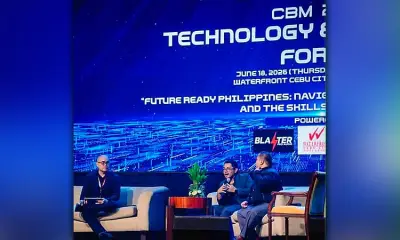
Speaking before business leaders in Cebu, Lim urged companies to adopt what he called a human-centered approach to AI, arguing that Filipino strengths in relationship-building, judgment, empathy and leadership remain difficult for machines to replicate.
“Augment your people before you automate everything,” Lim said. “The companies that will win the next decade are not necessarily the ones that automated the fastest. They are the ones whose people felt invested in, not replaced by technology.”

AI Concerns and Opportunities
His remarks come amid growing concerns that advances in generative AI could eliminate jobs across industries ranging from customer service and accounting to legal and administrative work.
While AI is increasingly capable of handling routine and repetitive tasks, Lim said many of the skills that define effective leadership and customer engagement remain uniquely human.
“For deeper judgment work, strategy, negotiation, reading a room, building relationships and leading through ambiguity, the gains from AI are smaller for now,” he said. “Those happen to be the things many business leaders and professionals do every day.”
Cost-Cutting Trap
Lim said companies that view AI solely as a cost-cutting tool risk undermining employee trust and missing opportunities to improve productivity through human-machine collaboration.
“The temptation is to focus entirely on efficiency,” he said. “But the human side becomes even more important as technology becomes more powerful.”
BPM Industry as Model
The MAP chief pointed to the Philippine business process management (BPM) industry as an example of how AI can complement rather than replace workers.
The industry, one of the country’s largest employers, is projected to continue expanding despite growing automation. Under the emerging model, AI handles routine inquiries and repetitive processes while human agents manage customer relationships, problem-solving and complex interactions that require empathy and judgment.
“That’s a better job. That’s a higher-value job,” Lim said. “The model is not AI replacing the agent. The model is AI handling routine work while people focus on what humans do best.”
Leadership and Investment Needed
He warned, however, that achieving such an outcome will require deliberate leadership decisions, investments in employee development and a corporate culture that embraces continuous learning.
According to international estimates cited by Lim, AI and related technologies are expected to create about 170 million jobs globally by 2030 while displacing 92 million existing positions.
The challenge, he said, is ensuring workers acquire the skills needed for emerging roles.
“The issue is not whether jobs will exist. The issue is whether people are prepared for them,” he said.
Reskilling as Strategic Priority
Lim noted that workers with AI-related skills are already earning salary premiums in some industries, while the World Economic Forum estimates that nearly 60 percent of the global workforce will require reskilling or upskilling within the next few years.
For Philippine companies, this means treating workforce development as a strategic business priority rather than a periodic human resources activity.
“Reskilling cannot live in a corner of HR’s annual training schedule,” Lim said. “It has to be measured, budgeted, reported and owned at the leadership level.”
Filipino Competitive Advantage
Beyond productivity gains, Lim said the Philippines has an opportunity to differentiate itself globally by combining technology adoption with the country’s longstanding strengths in service, collaboration and community-oriented leadership.
“That is a Filipino competitive advantage,” he said. “Do not give it up in the name of efficiency.”

Choice Between Futures
Lim framed the challenge facing businesses as a choice between two possible futures: one where AI and workers advance together, boosting productivity and creating new opportunities, and another where technology outpaces the workforce’s ability to adapt.
“The technology will be the same,” he said. “The difference will be the choices leaders make today.”
As AI adoption accelerates across industries, Lim said business leaders must remember that technology alone will not determine success.
“The future of work in your company is not something that will happen to you,” he said. “It is something you decide.”