The business sector in Cebu described the ongoing rotational brownouts in parts of the Visayas as still manageable for now. However, they warned that if the power shortage persists, it could disrupt operations, increase costs, and add to the difficulties of companies already facing various economic crises.
Regan Rex King, president of the Cebu Chamber of Commerce and Industry (CCCI), said most brownouts last only about an hour, allowing many businesses, factories, and establishments to continue operations through temporary adjustments and contingency measures.
“Honestly, the rotational brownouts have affected work, but the blackouts now only last about an hour, so they are still manageable,” King said.

The chamber noted that companies have adapted and adjusted to the power interruptions, especially since they are short and scheduled.
“Factories and the business community have also devised ways to adapt and adjust,” he added.
Despite this, the chamber acknowledged growing concern in the business sector due to the Visayas repeatedly being placed under “yellow alert,” thin power reserves, and the lack of clarity on when supply will return to normal.
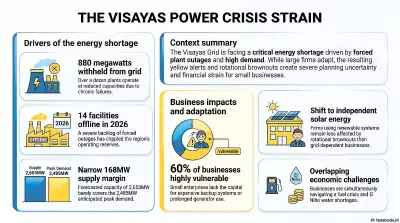
The National Grid Corporation of the Philippines (NGCP) raised the Visayas Grid to yellow alert on Friday, warning that power reserves are insufficient for emergency needs amid the shutdown of several power plants and high electricity demand.
A yellow alert is declared when power reserves fall below the required contingency reserve of the transmission grid, increasing the risk of rotational brownouts if another major power plant suddenly shuts down.
Although businesses have managed the recent brownouts, the lack of clarity on when the problem will end has become a major concern for companies planning their operations, investments, and production schedules.
“What businesses are really worried about is this: When will this end? Is it a short-term or long-term problem?” King asked.
He explained that most companies already have long-term operational plans and business projections, but due to the ongoing power problem and other emerging crises, they are forced to change their strategies on short notice.
Because of this lack of clarity, it is difficult for companies to make accurate projections, especially for businesses that rely heavily on uninterrupted power supply. He said businesses cannot properly calibrate their plans if they do not know whether this crisis will be short or long.
He also mentioned that many companies are already facing a series of problems aside from power supply, including rising oil prices and the potential impact of the approaching El Niño on water supply.
Other businesses, especially larger companies and commercial facilities, have started investing in solar energy systems and backup generators to mitigate the impact of blackouts.
However, the chamber pointed out that many companies, particularly micro, small, and medium enterprises (MSMEs), do not have enough funds to install large backup systems or run generators for extended periods.
Currently, the CCCI has over 880 members and is nearing the 900-member mark, with about 60 percent composed of MSMEs. These small businesses are more vulnerable to sudden operational shutdowns, unexpected power costs, and prolonged outages of basic utilities like electricity and water.
Despite the situation, the chamber said many businesses have not yet heavily relied on generators because the brownouts are short. According to King, since the situation is still manageable, businesses have not resorted to immediate use of generators.
The business sector is closely monitoring how the national and local governments are responding to the series of power alerts and whether they will implement long-term solutions to stabilize the power supply in the Visayas.
The chamber also hopes that the ongoing repairs of major power plants will eventually ease the situation and prevent wider blackouts across the Visayas in the coming months.