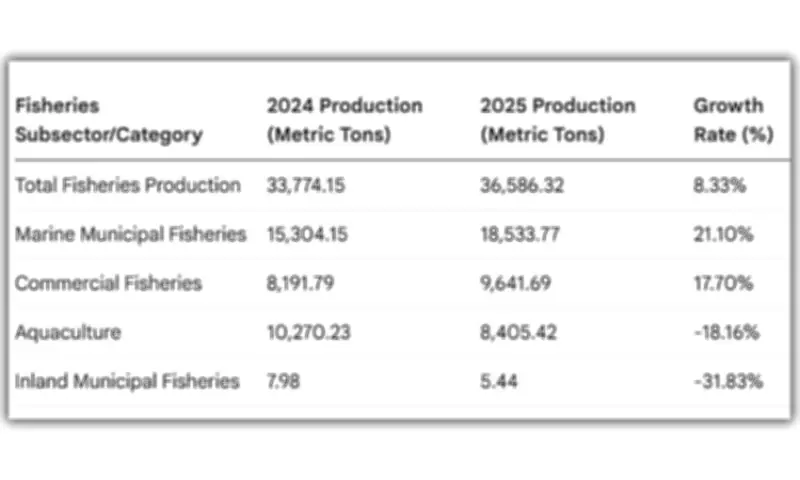
Cebu's total fisheries production reached over 36,500 metric tons in 2025, an 8.33 percent increase from 33,774.15 metric tons in 2024, according to the Philippine Statistics Authority (PSA). The growth was driven by a recovery in commercial and marine municipal fishing, which overcame previous declines to become the primary driver of the local fishing industry.
Marine Municipal Fisheries Rebound
Marine municipal fisheries, the largest contributor to total fisheries volume, produced 18,533.77 metric tons in 2025, a 21.10 percent increase from 15,304.15 metric tons in 2024. This subsector accounted for 50.66 percent of Cebu's total fisheries production. The rebound was fueled by massive production spikes in specific fish varieties.
Anchovies, known locally as dilis, led production with 4,876.47 metric tons, a staggering 1,334.26 percent increase from 340 metric tons in 2024. Siganid, or samaral, surged by 1,042.24 percent to 2,186.01 metric tons. Indian mackerel, or alumahan, grew by 52.57 percent to 2,008.62 metric tons, while Bali sardinella, or tamban, climbed by 304.93 percent to 1,610.49 metric tons. In contrast, big-eyed scad, or matangbaka, declined sharply by 59.75 percent to 1,420.67 metric tons, indicating a shift in market supply trends.

Municipal fisheries involve fishing in marine waters within 15 kilometers from the shoreline using small boats of three gross tons or less. Data were collected through the Quarterly Municipal Fisheries Survey (QMFS).
Commercial Fisheries Growth
The commercial fisheries subsector also saw positive movement, with production reaching 9,641.69 metric tons in 2025, up 17.70 percent from 8,191.79 metric tons in 2024. Fimbriated sardines, or tunsoy, led commercial fish production with 2,543.06 metric tons. Roundscad, or galunggong, ranked second, with output rising by 28.90 percent to 1,970.35 metric tons.
Commercial fisheries operate in marine waters beyond 15 kilometers from the shoreline using boats weighing more than three gross tons. Data were gathered through the Quarterly Commercial Fisheries Survey (QCFS).
Aquaculture Decline
Despite gains in other sectors, aquaculture production declined by 18.16 percent to 8,405.42 metric tons from 10,270.23 metric tons in 2024. Production from brackishwater fishponds fell sharply by 45.72 percent to 3,402.18 metric tons. In contrast, seaweed production increased by 20.84 percent to 3,462.13 metric tons. Freshwater fishponds posted the highest growth rate at 70.39 percent, though production volume remained low at 48.63 metric tons.
Aquaculture covers the farming of fish and other aquatic species in facilities such as fishponds, fish pens, and fish cages, including oyster, mussel, and seaweed culture. Data were collected through the Quarterly Aquaculture Survey (QAqS).
Inland Fisheries Continue to Drop
Inland municipal fisheries, which include fishing in lakes and rivers, continued to decline in 2025. Production dropped by 31.83 percent to 5.44 metric tons from 7.98 metric tons in 2024. The PSA noted that this subsector contributes only a minimal share to Cebu's overall fisheries production.
Inland fisheries involve fishing in inland waters using boats weighing three gross tons or less, or without boats. Data were gathered through the Quarterly Inland Fisheries Survey (QIFS).
The 2025 figures are based on quarterly surveys of commercial fisheries, municipal fisheries, and aquaculture farms across Cebu. Officials said the data remain preliminary and may change once validation is completed.