The Department of Tourism-Davao Region (DOT-Davao) and the Davao City Tourism Operations Office (CTOO) are actively exploring the development of Community-Based Tourism (CBT) in the areas of Tambobong in Baguio District and Datu Salumay in Marilog District. This initiative is being pursued in partnership with the Indigenous Peoples (IPs) residing in these regions, aiming to generate sustainable livelihood opportunities for the local communities.
Assessing Tourism Potential
Regional Director Tanya Rabat-Tan of DOT-Davao stated that their visit to Tambobong and Datu Salumay was intended to evaluate how the department could assist in unlocking the tourism potential of these areas. Following their inspection of Tambobong, she noted that tourism awareness training could commence, as the area currently has no established tourism activities.
Willenito P. Tormis Jr., officer-in-charge of CTOO, explained that their office's visit was focused on determining the feasibility of implementing CBT. He emphasized that through CBT, they could provide sustainable livelihood opportunities for IP communities.

Guidance from the Obu Manuvu Tribe
Tan expressed appreciation for the Obu Manuvu tribe of Tambobong, who provided a book that will serve as a guide in crafting CBT in the area. This is particularly important as certain parts of the ancestral domain are off-limits to the public.
Following the awareness training, the department will conduct validation trips and site visits to assess the areas and determine whether the proposed sites are suitable for CBT development.
"There are still a lot of groundwork activities to be done, such as assessing the sites and conducting validations. Of course, we also have to talk with the community about the activities they are open to," Tan said in a media interview.
She added that once these steps are established, tour operators will be invited to inspect the sites and integrate them into their itineraries.
Timeline and Expectations
Tan expressed hope that the establishment of CBT in these areas would be completed within the year, although she acknowledged that product development takes time. However, she is confident that once validation and community consultations are completed, they can proceed with engaging tour operators.
She further noted that the establishment of CBT will not only strengthen the tourism sector but also improve the livelihood of the community.
Community-Based Tourism Ordinance
To effectively implement CBT in the city, CTOO is crafting a proposition framework for an ordinance on CBT. They are coordinating with other agencies, stakeholders, and legislators.
Tormis said that consultative meetings with various sectors have already been conducted and the ordinance is being finalized. He noted that the city currently has only one accredited CBT, which has not been well-maintained.
He added that to maximize the potential of CBTs in the city, an ordinance is needed to guide the accreditation and management of CBT areas. The purpose of CBT is to help promote the area and capacitate the community.
"Dili nato siya ma-fully [implement] kung wala tay tarong na framework ug tarong na process for it. Mao na atoang gina-develop karon with the help of different sectors (We cannot fully implement it if we do not have a proper framework and a proper process for it. That is what we are currently developing with the help of different sectors)," he said.
Tormis said that the possible addition of CBT sites in Davao City could boost the local tourism sector, especially since most tourism sites have already been identified, making new additions through CBT a welcome development.
He also emphasized that implementing CBT in IP communities would highlight Indigenous culture beyond the Kadayawan Festival and the Cultural Village in Magsaysay Park.
However, Tormis said they are strict in accrediting CBTs in the city to ensure that incidents like the Mini Asik-Asik Falls case will not happen.
Helpful for IP Communities
The Obu Manuvu community said that the visit of DOT and CTOO is a rare opportunity for them, especially in promoting advocacy and CBT development in their area without compromising their ancestral domain and the Philippine Eagle habitat within it.

Datu Lipatuan Joel Unad Sr. of the Obu Manuvu Unified Ancestral Domain of Elders and Leaders said they are grateful for the initiative, noting how CBT could boost the livelihood of the IP community.
"Dako kaayo ni ng opportunity sa tribo o benepisyo sa tribu kung unsay mahitabo ani nga planuhan (This is a very big opportunity or benefit for the tribe, whatever will come out from this plan)," he said in a media interview.
This will be the first CBT proposal in Tambobong. DOT said they will conduct assessments and consultations with the Obu Manuvu to determine the most appropriate CBT model for the area.
For the Matigsalug tribe, which already has an existing CBT since 2018, they raised concerns and requested assistance from DOT and CTOO. Both offices assured them of support through training and guidance in managing their CBT.
Their concerns include the lack of capacity-building training, limited organizational development, insufficient tourism product development strategies, and the lack of income-generating activities for locals.
Visit to Tambobong and Datu Salumay
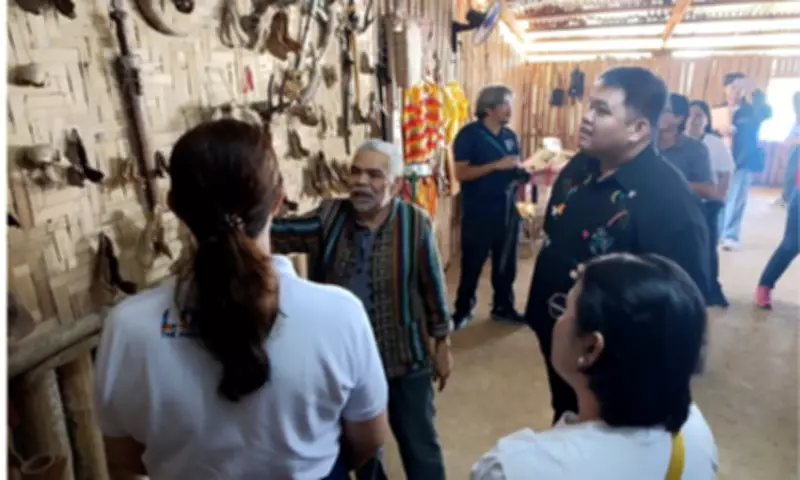
DOT and CTOO conducted a site visit to Tambobong and Datu Salumay on May 6, 2026, to inspect the areas and engage with Indigenous Communities (ICs) for consultation on the most suitable CBT model for each location.
The Obu Manuvu showcased parts of their ancestral domain that could be opened to tourists. One highlight is a view deck that offers a panoramic view of the mountains and forests within the ancestral domain.
Tourists may also experience the culture of the Obu Manuvu through immersive activities. Datu Unad Sr. demonstrated traditional hunting knowledge, games, and cultural practices. Visitors may also learn how to make traditional fiber brooms, one of the tribe's main livelihood sources, through demonstrations led by Obu Manuvu women.
The Matigsalug tribe, moreover, showcased local food, weaving practices such as banig and bag-making using rattan, and beadwork, which serve as potential income-generating products for tourists.