Davao Oriental Inflation Climbs to 2.1% in December 2025 Following Earthquake Disruptions
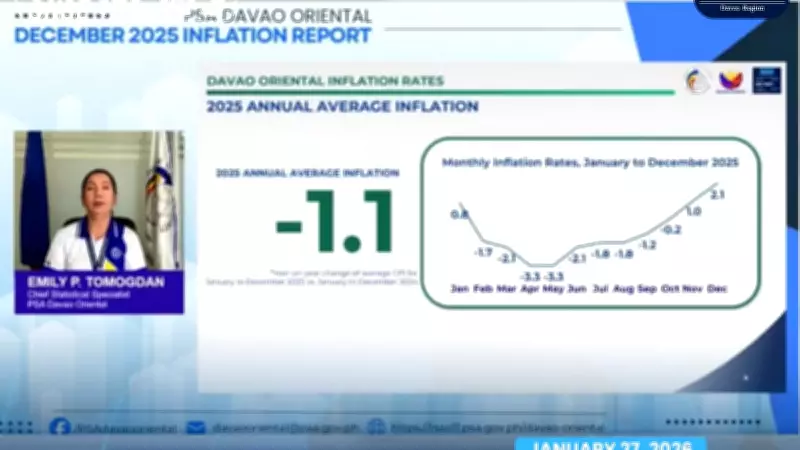
The Philippine Statistics Authority (PSA) Davao Oriental has released its latest inflation report, revealing a notable increase in the province's inflation rate for December 2025. According to the data, the inflation rate reached 2.1 percent, marking a significant rise from the 1.0 percent recorded in November 2025 and a substantial jump from the 0.7 percent posted in December 2024. This upward trend highlights the economic challenges faced by the region as it grapples with both natural disasters and market fluctuations.
Earthquake Impact and Panic Buying Drive Inflation Surge
Emily P. Tomogdan, chief statistical specialist at PSA Davao Oriental, emphasized that while supply-and-demand factors typically influence inflation, the recent series of earthquakes with epicenters in the province played a crucial role in the December 2025 increase. During an online inflation report presentation, Tomogdan explained, "The series of earthquakes had an effect since supermarkets closed, which led people to panic buy." She further noted that such events can cause changes in demand and supply, leading to price volatility, particularly for agricultural products that are easily affected by calamities or adverse weather conditions.
Key Contributors to the Inflation Rate
The acceleration in Davao Oriental's inflation rate in December 2025 was primarily driven by the faster year-on-year increase in prices of food and non-alcoholic beverages. This commodity group posted a 2.2 percent inflation rate and accounted for 89.3 percent of the upward movement in the overall inflation rate. Within this category, specific items showed notable increases:

- Fish and other seafood recorded a 7.8 percent inflation rate.
- Meat and other parts of slaughtered land animals posted a 5.8 percent inflation rate.
- Vegetables, tubers, plantains, and cooking bananas registered a 3.8 percent inflation rate.
Housing, water, electricity, gas, and other fuels emerged as the second-largest contributor, with a 3.6 percent inflation rate and a 26.4 percent share of the province's general inflation for the month. Under this group, electricity saw a significant 10.4 percent inflation rate, while maintenance of the dwelling recorded a modest 0.4 percent increase.
Additionally, personal care and miscellaneous goods and services were the third commodity group with the largest contribution, posting a 3.3 percent inflation rate and accounting for 7.5 percent of the province's general inflation in December 2025.
Price Changes and Consumer Impact
When asked about the specific price changes in the market due to inflation, Tomogdan noted that variations exist. "It varies, sometimes only by a few centavos. For food and agricultural products, there may be no change at times, but if there is, the increase can be more than a peso," she shared. For instance, the price of rice rose from P57 per kilo in December 2024 to P59 per kilo in December 2025, while white corn increased from P33 to P37.25 over the same period. These examples illustrate how inflation directly affects everyday expenses for consumers in Davao Oriental.
Annual Inflation Trends and Data Collection
Despite the December 2025 increase, Davao Oriental's average inflation rate for the entire year of 2025 remained low at –1.1 percent, which is significantly lower than the 3.7 percent recorded in 2024. This indicates that while short-term spikes occurred, the overall economic performance for the year was relatively stable.
Tomogdan explained that inflation is measured using the Consumer Price Index, which tracks changes in the average prices of goods and services commonly purchased by consumers relative to a base year. In Davao Oriental, data for computing the inflation rate are gathered from various outlets across the province, including Baganga, Manay, Mati City, Lupon, and Governor Generoso, ensuring a comprehensive and accurate representation of price movements.