Mindanao's Energy Revolution: From Shortages to Supplying the Nation
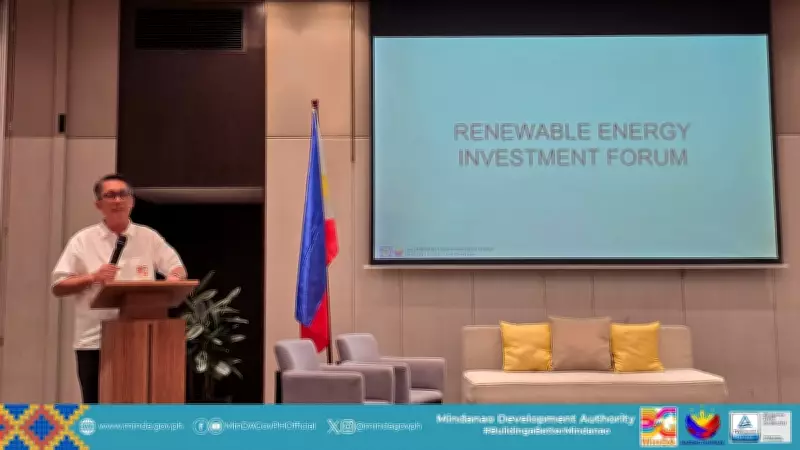
In a landmark address at the Energy Investment Forum on Friday, February 13, Mindanao Development Authority Chairperson Secretary Leo Tereso Magno proudly declared Mindanao's dramatic transformation from a region plagued by energy insecurity to a vital power exporter for the Philippines. Speaking before a distinguished audience of energy officials, investors, and foreign dignitaries, Magno highlighted this pivotal shift as a cornerstone of regional and national progress.
From Struggle to Surplus: A Grid Transformed
Secretary Magno began by reflecting on Mindanao's challenging past, recalling years of supply shortfalls that stifled investments and limited economic opportunities across the island. "Now, we can proudly say we supply, I think 400 megawatts... of the power that we produce in Mindanao to Visayas and Luzon," Magno stated, emphasizing the region's new role as a key contributor to the national energy grid.
This achievement is largely enabled by the ₱51 billion Mindanao Visayas Interconnection Project (MVIP), completed between 2023 and 2024. According to the National Grid Corporation of the Philippines (NGCP), this critical infrastructure allows for the transfer of up to 450 megawatts of electricity between Mindanao and Visayas, with potential expansion to 900 MW. This milestone confirms Magno's assertion, as Mindanao's surplus power now flows into the national grid, supplying approximately 400 MW to Luzon and Visayas.

Supporting this view, the Institute for Climate and Sustainable Cities (ICSC) reported in 2025 that Mindanao's grid not only meets local demand but also generates excess capacity for export to Visayas, underscoring the region's energy resilience.
Partnerships and Future-Proofing Energy Security
Magno expressed deep gratitude to the Department of Energy (DOE) for its collaborative efforts, particularly through the co-chairing of the Mindanao Power Monitoring Committee. This partnership has been instrumental in addressing historical power challenges and ensuring grid stability. However, Magno cautioned that while current supply is sufficient, stakeholders must proactively plan for future energy resilience and sustainability to maintain this positive trajectory.
The Secretary also spotlighted the crucial role of renewable energy investments in positioning Mindanao as a reliable hub for industries. "We remember the days when people would not look at Mindanao as an investment hub. Today, with reliable energy and strong partnerships, we are ready to welcome investors and drive inclusive growth," he affirmed, linking energy stability to broader economic development.
Aligning with National Renewable Energy Goals
Magno's remarks directly resonate with President Ferdinand Marcos Jr.'s climate and development agenda, which places renewable energy at its core. President Marcos has consistently pledged to expand hydropower, geothermal, solar, and wind projects as part of the Philippines' transition to cleaner energy sources. In his first State of the Nation Address, Marcos emphasized that renewable energy adoption would be a cornerstone of his administration's strategy to combat climate change and enhance energy security.
Recent initiatives under the Marcos administration further highlight efforts to expand universal electricity access and strengthen collaborations with private utilities. In February 2026, Meralco reaffirmed its support for the national energy agenda alongside President Marcos, committing to boost renewable energy adoption and ensure electricity reaches underserved communities across the nation.
A National Milestone in Energy Transition
Secretary Magno's presentation at the Energy Investment Forum vividly illustrates Mindanao's capacity to export power and attract renewable energy investments, aligning seamlessly with President Marcos Jr.'s vision. His message reinforces the administration's broader objective: building a resilient, interconnected, and sustainable energy system that fosters inclusive growth throughout the Philippines.

Mindanao's evolution from a deficit-ridden region to a surplus power supplier represents not merely a regional triumph but a significant national milestone in realizing the country's energy transition. This transformation underscores the potential for strategic infrastructure projects and policy alignment to drive sustainable development, setting a precedent for other regions to follow in the pursuit of energy independence and economic vitality.