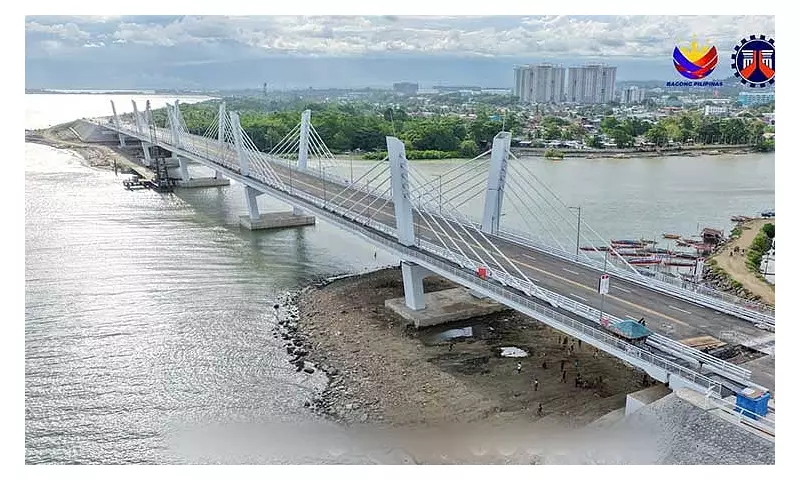
The Department of Public Works and Highways has announced that the highly anticipated Bucana Bridge in Davao City is nearly finished, with completion reaching 99.2 percent. Officials confirm the structure remains on schedule for its official public opening in December 2025.
Final Push for Completion
During a recent site inspection, DPWH Senior Undersecretary Emil Sadain reported that the remaining minor works are slated for completion by the end of November. These final touches include installing pavement markings on Approach Road 1, completing sidewalks and fencing, and carrying out the final electrical system connections.
"Our priority is to deliver this bridge with the highest level of quality, safety standards, and structural integrity," Sadain emphasized. He added that the team is expediting all final requirements to meet the deadline. The bridge's inauguration is contingent upon the DPWH–Davao Region finishing the asphalt overlay on Quezon Boulevard, the main access route for the new bridge.

A Transformative Project for Davao
Constructed under the directive of President Ferdinand 'Bongbong' Marcos Jr., the Bucana Bridge is a critical component of the Davao Coastal Road project. Its primary goal is to alleviate the city's chronic traffic congestion and dramatically improve connectivity between the eastern and western coastal areas.
The project, which broke ground in November 2023, is a four-lane, six-span extradosed bridge stretching 480.20 meters, complemented by 1,340 meters of approach roads. Funded by a P3.126-billion Official Development Assistance grant from China, it is being implemented by the Unified Project Management Office–Bridges Management Cluster.
Once operational, the bridge is projected to handle approximately 35,000 vehicles daily, serving as a major alternative route that bypasses Davao's congested downtown core.
Economic Boost and Community Concerns
The economic implications are significant. The improved east-west link is expected to facilitate commerce, enhance the movement of goods, and drive regional economic growth, particularly benefiting the agricultural and fishing sectors. Furthermore, reduced travel times and better infrastructure are poised to give local tourism a considerable boost, providing easier access to scenic areas and spurring new enterprises.
However, the project has not been without criticism. Some local fisherfolk from the Bucana area have voiced concerns about the bridge's low clearance, stating that it prevents their boats from passing underneath at high tide, thereby impacting their primary source of income. This highlights the ongoing challenge of balancing large-scale infrastructure development with the needs and livelihoods of local communities.
In conclusion, the Bucana Bridge stands ready to become a cornerstone of Davao City's infrastructure, promising to reshape its traffic landscape and unlock new economic opportunities, while its challenges underscore the importance of continued dialogue and responsive governance.