Davao Light Exceeds Spaghetti Wire Clearance Target with 52 Kilometers Removed
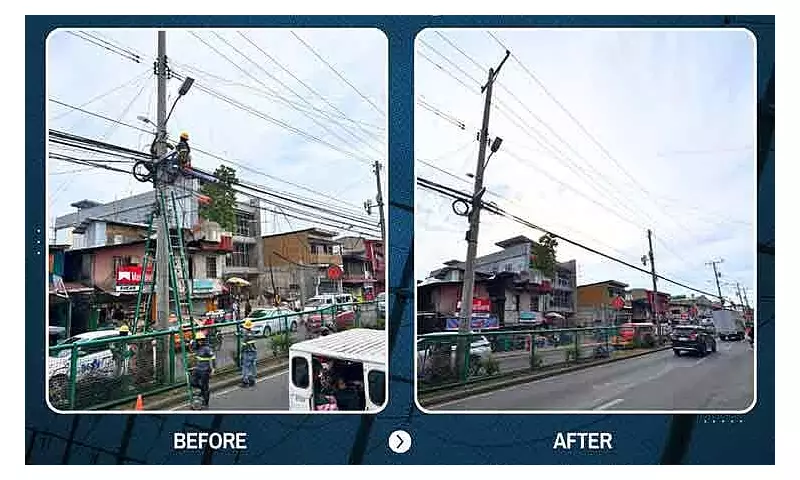
The Davao Light and Power Company (Davao Light) has announced a significant achievement in urban cleanup, reporting the clearance of approximately 52 kilometers of dangling wires from the streets of Davao City in 2025. This accomplishment far surpasses the company's initial target of 10 kilometers set for 2024, demonstrating substantial progress under the city's Anti-Spaghetti Wire Ordinance.
Detailed Progress and Infrastructure Improvements
According to Fermin Edillon, head of Davao Light's Reputation Enhancement Department, the utility company has cleared 52.25 kilometers of wires as of January 26, 2026, since the ordinance took effect in February 2024. In addition to wire removal, Davao Light has installed 3,990 telecommunications brackets to support organized infrastructure. The 2024 operations focused primarily on the downtown area, aligning with the city's underground cabling project. Key streets cleared during this period included:
- Rizal Street
- Bolton Street
- Iñigo Street
- Various other downtown locations
Future Priorities and Expansion Plans
For 2026, Davao Light has identified several priority areas for continued wire clearance efforts. These locations include:

- Quezon Boulevard from Agdao Flyover to Bolton Bridge
- Ebro Pelayo Street
- Guerrero Street (from Aurora Street to Polo Street)
- Loyola Street
- F. Torres Street
- Magallanes Street
- Tulip Drive
- Jacinto Street
- Sandawa Street
- Ecoland Drive
- Dacudao Avenue
- The entire stretch of McArthur Highway
Edillon emphasized that while the ordinance covers all of Davao City, the company coordinates closely with the City Government of Davao, particularly the City Engineer's Office, to identify priority areas. "The coverage is the entire Davao City, but we are closely coordinating with the City Government of Davao, particularly the City Engineer's Office, because they are the ones tasked with identifying which areas are the government's priority areas," he explained.
Safety and Aesthetic Benefits
In an interview at the Sangguniang Panlungsod on January 20, 2026, Edillon highlighted that the Anti-Spaghetti Wire Ordinance serves dual purposes: ensuring public safety and improving urban aesthetics. The collaboration between Davao Light and telecommunications companies focuses not only on enhancing the city's appearance but also on eliminating potential hazards from dangling wires.
Regional Expansion and Municipal Cooperation
The success in Davao City has prompted expansion to neighboring localities. Edillon reported that Davao Light has made progress in Sto. Tomas and Carmen in Davao del Norte after each municipality passed its own version of the Anti-Spaghetti Ordinance in December 2024. Specific achievements include:
- Carmen: 12.15 kilometers of roads cleared
- Sto. Tomas: 21 kilometers free of spaghetti wires
Additionally, the Municipality of Braulio E. Dujali and Panabo City are currently in the process of passing similar ordinances, indicating growing regional adoption of these safety measures.
Legal Framework and Compliance Requirements
The Anti-Spaghetti Wire Ordinance of 2023, approved by the Sangguniang Panlungsod, mandates utility companies to relocate their installations to dominant poles within seven days of receiving notice. This ordinance enforces compliance with Republic Act 11361, the "Anti-Obstruction of Power Lines Act," which ensures that sub-transmission and distribution systems remain unobstructed and safe.
Non-compliance results in a Notice of Violation or Compliance Order, with penalties of P300 per pole per day until resolution. Continued failure to comply may lead to the non-renewal of business permits, underscoring the seriousness of the regulatory framework.
The comprehensive efforts by Davao Light represent a significant step toward safer, more organized urban infrastructure in Davao City and surrounding areas, balancing regulatory compliance with community benefits.