Business leaders are warning that the recent red alerts and rotational brownouts in the Visayas and Luzon could hurt productivity, weaken investor confidence, add to inflation pressures and make the country’s power supply problem look like a national economic risk.
Why business is worried
Power interruptions raise the cost of doing business. Companies lose operating hours, run generators, delay production, or spend more just to keep stores, plants and offices open. For investors, an unstable power supply is a warning sign. A country may offer workers, markets and incentives, but if electricity is unreliable, expansion becomes riskier and more expensive.
PCCI president Perry Ferrer said brownouts could further weaken productivity, investor confidence and household welfare at a time when growth is already under pressure and inflation is rising.

Immediate trigger
The National Grid Corp. of the Philippines (NGCP) placed the Visayas grid under yellow and red alerts starting Tuesday, May 12. A red alert means the power supply is not enough to meet demand and the grid’s required reserve. In plain terms, the system is short of electricity, making rotational brownouts likely. A yellow alert means reserves are thin, although supply can still meet demand. On Friday, May 15, the Visayas grid had 2,379 megawatts of available capacity against peak demand of 2,574 megawatts. NGCP said plant outages, derated power plants and higher demand worsened the situation.
Not just lack of power plants
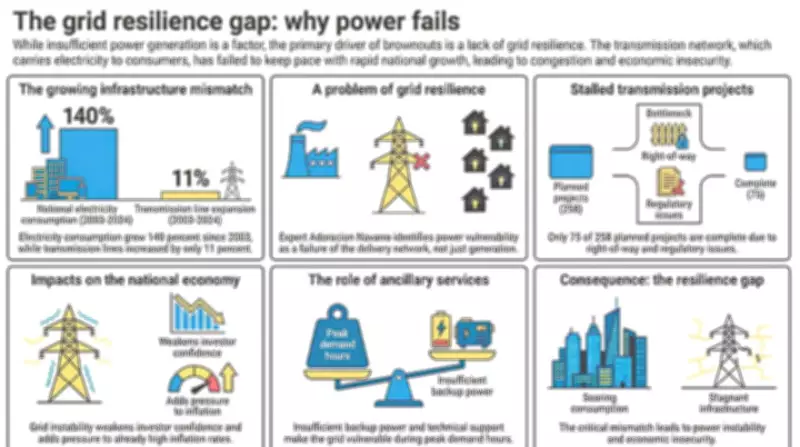
The brownouts are not only about insufficient generation. They also point to weaknesses in the transmission system, the network that carries electricity from power plants to consumers. Adoracion Navarro, senior research fellow at the Philippine Institute for Development Studies, said the country’s power vulnerability is increasingly a grid resilience problem. Her data showed that electricity consumption grew by about 140 percent from 2003 to 2024, while transmission lines increased by only 11 percent. That mismatch has contributed to congestion, reliability problems and energy insecurity.
Where NGCP is being questioned
NGCP operates, maintains and develops the country’s transmission grid. Navarro said it has completed only 75 of 258 planned transmission projects. The delays have been linked to weak regulation, right-of-way problems and poor coordination among government agencies. Right-of-way means securing permission to use land for transmission towers, lines and related facilities. When those permits and land issues are delayed, power projects that depend on the grid are also delayed.
Other weak points
Navarro also pointed to inadequate ancillary services, technical constraints, insufficient transmission capacity, grid congestion and the lack of transmission links in some renewable energy zones. Ancillary services are backup power and technical support that help keep the grid stable when demand rises or when power plants suddenly go offline. Without enough of these services, the grid becomes more vulnerable during peak hours, especially in the hot months when electricity demand climbs.
How Cebu firms responded
In Cebu, several large establishments shifted to their own generators under Visayan Electric’s Interruptible Load Program. Among those that deloaded from the grid were SM establishments, Gaisano Country Mall, J. King & Sons, Mabuhay Filcement, Cemex, Taiheiyo Cement and San Miguel Corp. The idea is to free up supply for households and smaller consumers. When big users stop drawing from the grid during a red alert, the available power can be spread to more homes and businesses.
What’s at stake
PCCI warned that prolonged brownouts could weaken productivity, investor confidence and household welfare, while also worsening inflationary pressures. For households and businesses, that could translate into disrupted routines, higher operating costs and lost economic activity. Central Visayas inflation stood at 10.8 percent in April, while Cebu Province logged 12.9 percent. A power crisis could add another burden to consumers and firms already dealing with rising costs.

What we don’t know yet
It is still unclear how long the red alert conditions will continue, how quickly offline or derated power plants can return to full capacity, and whether more outages will occur as demand remains high. The bigger unknown is whether delayed transmission projects will be completed faster and whether regulators will impose stronger accountability on NGCP and other agencies involved in grid development. It is also unclear whether reforms will move quickly enough to support renewable energy projects that need transmission lines before they can reliably deliver electricity to consumers.
What’s next
In the short term, utilities may continue using rotational brownouts and interruptible load programs to manage supply shortages. In the long term, the pressure will be on the government, regulators, NGCP and energy players to speed up transmission projects, improve coordination, secure reserves and make the grid more reliable. The brownouts may be temporary. But the business worry is that unless the grid catches up with demand, the power problem could keep returning, with costs carried by consumers, companies and the economy.