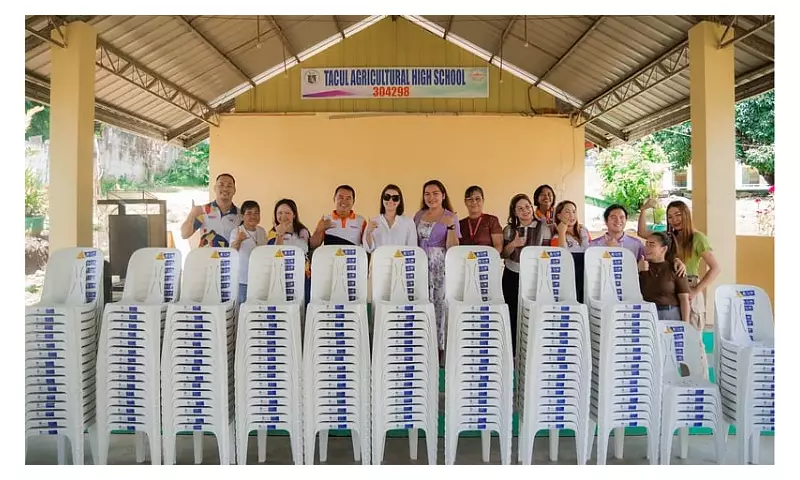
Governor Yvonne Roña Cagas personally oversaw the distribution of hundreds of monobloc chairs to multiple public schools throughout Davao del Sur on Friday, November 7, 2025. This educational support initiative reached both elementary and secondary institutions across several municipalities, providing practical assistance to improve learning environments.
Schools Benefiting from the Donation
The chair distribution program extended to schools in Magsaysay, Malalag, Hagonoy, and Digos City. Specific beneficiaries included Tacul Agricultural High School and Tacul Agricultural Senior High School in the agricultural sector, along with San Isidro Elementary School and Glamang Elementary School in Magsaysay. Other recipients were Ngub Primary School in Barangay Mabini, Malalag; Apolonio R. Fuentes Sr. Elementary School in Barangay Kibuaya, Hagonoy; and Pedro Basalan Elementary School in Barangay Tres de Mayo, Digos City.
Governor Cagas emphasized the importance of supporting education, stating in both English and Cebuano: "Education will always be worth supporting. Chair distribution sa atong mga public schools — gamay nga tabang, dakong epekto!" (Chair distribution in our public schools — a small help with a big impact!).

Addressing Classroom Needs and Literacy Challenges
The governor described the donation as a simple yet practical intervention to enhance classroom conditions and student comfort. School furniture represents a fundamental but often overlooked component of the learning environment. In overcrowded or under-resourced classrooms, insufficient or damaged seating can reduce student comfort, distract attention, and complicate classroom management—all factors that potentially hinder learning effectiveness.
The new monobloc chairs are intended to replace worn or missing seats while helping teachers optimize classroom space utilization. This initiative comes against the backdrop of Davao del Sur's current educational landscape as revealed by the latest 2024 Functional Literacy, Education and Mass Media Survey (Flemms).
According to the survey results, Davao del Sur (excluding Davao City) recorded a basic literacy rate of approximately 90.2 percent, meaning nine out of ten people aged five and above can read and write simple messages and perform basic arithmetic. However, for functional literacy—the higher standard measuring the ability to read, compute, comprehend, and use information in daily life—the province recorded about 64.9 percent among the population aged 10 to 64.
Broader Educational Implications
The functional literacy rate of roughly 65 percent reveals two interconnected realities for Davao del Sur: significant progress in achieving basic reading and writing skills, yet persistent gaps in deeper comprehension and practical application. A substantial portion of learners still struggle with higher-order literacy skills essential for employability and informed citizenship.
Small, targeted investments like improving classroom furniture, ensuring adequate learning materials, teacher training on reading comprehension strategies, remedial programs for struggling learners, and community literacy initiatives can help bridge this gap. Governor Cagas's chair distribution represents one practical step addressing day-to-day learning environment challenges.
School administrators who received the chairs welcomed the donation as timely assistance, confirming they will inventory and assign the chairs to classrooms with the greatest need. They emphasized that sustained educational improvements will require coordinated efforts among provincial government offices, Department of Education schools division offices, and community stakeholders.
The national Flemms findings for 2024 show that basic literacy has risen to around 90 percent nationally, while functional literacy rates vary considerably between provinces and regions, highlighting disparities that education policies and local programs must address through continued investment and strategic interventions.