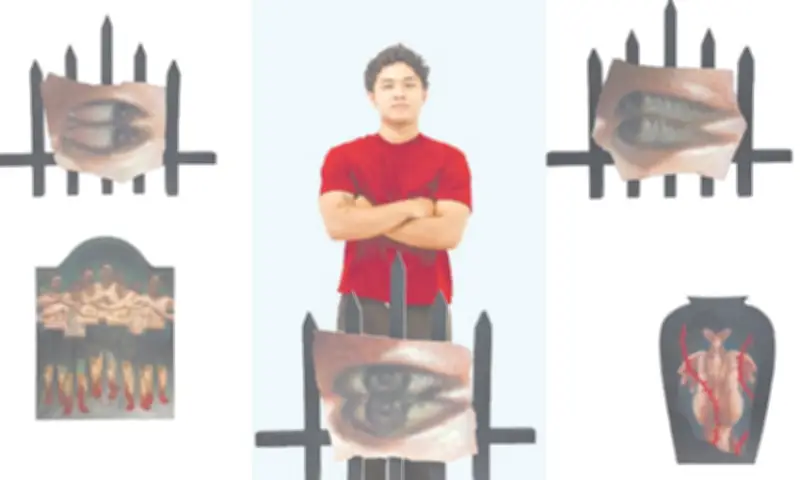
Cebu-based visual artist Densen Almeda challenges the notion that household objects are passive. In his solo exhibition “What the Silhouette Sustains,” he explores how everyday environments shape attention, behavior, and interactions.
The Architecture of Habit
The exhibition is rooted in Almeda’s home life, using silhouettes taken entirely from household items. Almeda stresses that his personal narrative serves as a vehicle for a wider conversation. “It’s reflected there, but people have their own discretion. It does not mean that they need to know your exact story,” Almeda said during an intimate walkthrough of the gallery. “The general idea is that the silhouettes instruct us on what we can usually do. You are under a pattern, you are under a system and you should be aware of that specific system. Then from there, you can act.”
These flattened outlines evoke the routines of everyday life. More than representations, they become forms that shape how the body stands, reaches, sits, and rests.

Diagnosing the Domestic Micro-System
A standout piece, “Perimeter Check,” captures the tense, hyper-aware atmosphere of life within a crowded family compound. “We live in a very busy neighborhood and there’s always drama,” Almeda said. “You can see the cycle and the pattern of how the neighborhood becomes very wary. Constantly checking, it is like a hyper-awareness of the environment. You could say that home doesn’t exactly feel like a completely safe space because of that.”
Where “Perimeter Check” monitors outward anxieties, other works turn inward. One silhouette features a simple chair, which Almeda says represents his mother. “My mother is a very quiet person,” he said. “If ever something is wrong, she just brushes it aside. I think that’s dangerous. She keeps it all inside. Those are the exact patterns of that behavior.”
Breaking up the exhibition are mounted sheets of ficem board, typically hidden beneath finished paintings. Here, they are left exposed — cracked and fragmented — to reveal the accumulated pressure of time and repeated use. Across these fractured surfaces, Almeda layers human figures and gestures, suggesting movements shaped by repetition and the spaces people inhabit.
Rather than judge these tensions, Almeda approaches them with empathy, choosing to remain within his domestic environment to observe and create. “I am always consistently learning the patterns within the family,” Almeda said. “But just because it is flawed doesn’t mean there is no hope or that it isn’t working. That is the goal in life, to put yourself in other’s shoes, to understand everything and why things happened.”
Creating with Intent
By examining familiar domestic habits, Almeda encourages viewers and fellow artists to first understand the spaces they inhabit before looking outward. The dynamics of a single home can reflect larger social structures. “Be aware and be informed of the systems that you are in,” Almeda said. “Start from the very intimate spaces that you occupy. You should be grounded in where you are. Be aware, be observant and know what fascinates you.”
“What the Silhouette Sustains” suggests that what a home sustains is more than its physical structure — it also preserves the routines and behaviors shaped within it.
This focus on spatial discipline requires deliberate creative execution. Rejecting art made for mere commercial gain, Almeda believes an artist must speak with clarity and precision. “For me, it always starts with intent. I need to know exactly what I want to speak about,” he added. “Its destination is something that is truly worth working for, not just painting for the sake of making something to sell. Speak with intent, do with intent.”