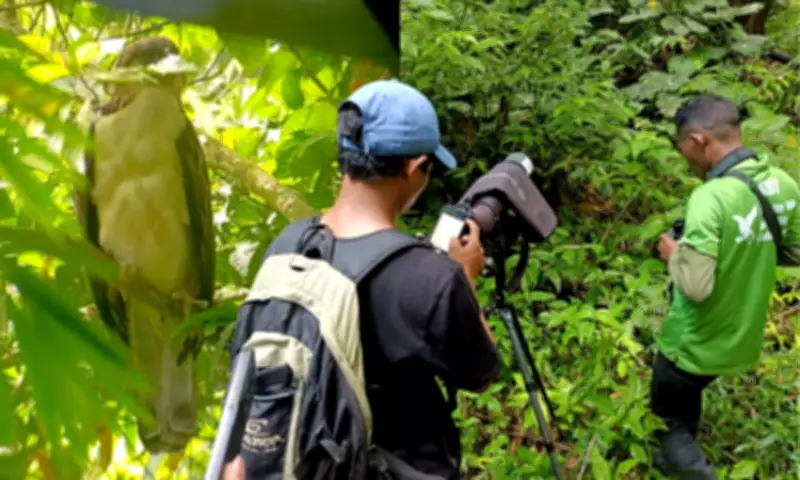
One year after its translocation, Philippine Eagle Lakpue was spotted at an altitude of about 288.9 meters MSL, perching on a Hagimit tree near the Pangalaw-an River in Barangay Mahagnao, Burauen, Leyte, on May 17, 2026. The eagle was observed through a field scope preening its feathers during a monitoring session.
Habitat and Behavior
Lakpue's current activity area spans approximately 613 hectares and continues to expand as the eagle explores new territories. It spends most of its time in riverine forests along the Marabong River in Mahagnao. Media representatives, along with Philippine Eagle Foundation (PEF) field technicians and forest guards, conducted monitoring via radio telemetry to document the species' behavior and safety post-translocation.
At 23 years old, Lakpue was rescued as a fragile nestling after being stolen from its nest in July 2003 on Mt. Busa in Maitum, Sarangani Province. It was nursed back to health at the Philippine Eagle Center in Davao City before being translocated and released on September 30, 2025, in Barangay Kagbana. This effort aims to repopulate the eagle population in the region, which was decimated by Typhoon Yolanda in 2013.

Dr. Jayson Ibañez, PEF director for operations, confirmed that Lakpue is adjusting well to its release area. The eagle is hunting independently, successfully catching monitor lizards, palm civets, and sailfin lizards. Lakpue remains within forested areas, rarely approaching houses or roads, and exhibits behaviors typical of wild eagles, such as hiding in thick foliage, walking along riverbanks and forest floors while hunting, and flying between trees in search of prey.
Protection and Monitoring
As a critically endangered species, the Philippine Eagle receives daily monitoring. Lakpue is fitted with satellite and radio transmitters to track its movements. Ibañez emphasized that constant monitoring reduces risks of shooting and trapping, as public awareness of surveillance discourages harmful actions. Monitoring also helps document behavior, movement, hunting patterns, and responses to the new environment, aiding in evaluating release methods and identifying necessary adjustments.
The foundation, in collaboration with local government units and other agencies, has conducted education campaigns in communities within a six-kilometer radius of the release site. These campaigns ensure residents are aware of Lakpue's presence and understand how to ensure its safety. Partnerships with the Philippine National Police strengthen enforcement against hunting and trapping, including support for a gun ban. The Municipality of Burauen has declared the Philippine Eagle its flagship species, adopting national laws and local measures for protection. Policy and funding support from the province of Leyte are also being secured to provide stronger and more sustainable conservation efforts.
Genetic Diversity and Future Prospects
The PEF earlier highlighted low genetic diversity among Philippine Eagles, particularly in Samar and Leyte, which could affect the species' future. Low genetic diversity increases the risk of reduced fitness, lower survival rates, and diminished adaptability in offspring. With the breeding season approaching in July, hopes are that Lakpue and Carlito, a female Philippine Eagle also translocated to Leyte, may pair up. While there is no guarantee, courtship and mating behaviors could begin if attraction and pair bonding occur.
“This kind of pairing may help strengthen genetic diversity, which is important for the long-term health of the Philippine Eagle population,” Ibañez said. If Lakpue and Carlito pair, their offspring would bring valuable genetic diversity, as both eagles originate from different mountain ranges—Carlito from Mt. Pasian in Agusan del Sur, Northern Mindanao, and Lakpue from Mt. Busa in Southern Mindanao. Their offspring would contribute two distinct genetic lines to the Leyte population.

Future Eagle Translocations
Given Lakpue's promising adaptation, the foundation is considering translocating more eagles to Leyte. Current assessments indicate that the Mt. Anonang-Lobi Range can support about 16 Philippine Eagles. Other translocated eagles, such as Carlito and Sinabadan, are also showing positive signs. Carlito was last seen actively hunting on November 6, 2025, while Sinabadan remains within forest interiors of the Marabong Watershed in Javier, with GPS data indicating active and well-adjusted behavior.
Addressing concerns following the drowning incident involving Philippine Eagle Uswag, Ibañez noted that working with living animals always involves risks, including death. Eagles die in the wild due to natural and human-related threats. The trial translocation in Leyte serves as a learning opportunity to reduce future losses. By monitoring each released eagle, methods can be improved to enhance survival chances. Information dissemination aims to increase public awareness and understanding of translocation efforts.
The foundation aims to release 11 additional eagles within the next three to four years, contingent on acquiring young or juvenile eagles from Mindanao with consent from communities, local government units, and the Department of Environment and Natural Resources (DENR). Ibañez expects some mortality, with a 25 percent rate implying that four out of 16 eagles may not survive. To date, five eagles have been released, requiring 11 more to reach the target. The Municipality of Javier has approved funding support from its municipal funds to host the next eagle release.
The goal of translocating Philippine Eagles from Mindanao to Leyte is to reintroduce juvenile eagles to the island. Leyte was chosen due to the absence of eagle sightings after Super Typhoon Yolanda in 2013, with no sightings recorded during subsequent annual surveys. The eagles are exclusively found on four islands—Luzon, Leyte, Samar, and Mindanao—which together host 60 percent of the population.