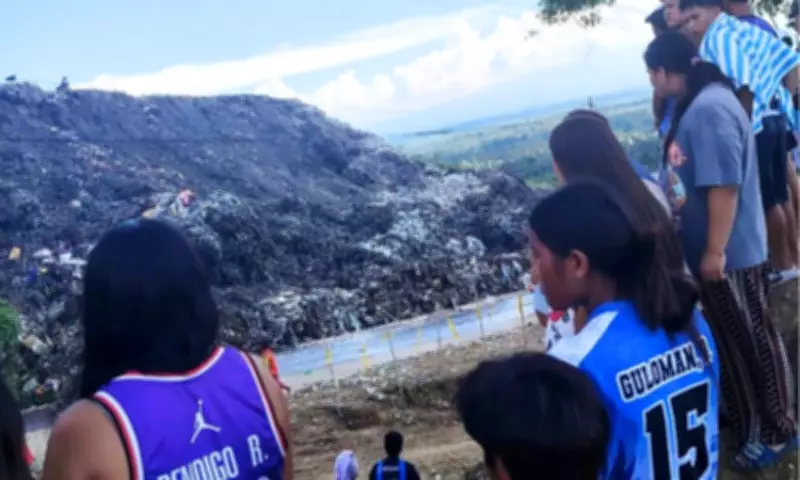
Heavy rains triggered a deadly garbage mound collapse at the New Carmen landfill in Davao City on Wednesday, May 20, 2026, burying nearby homes and causing casualties. The incident occurred around 1:17 p.m. in Barangay New Carmen.
Casualties and Response
Harvey Lanticse, head of the City Information Office, reported that as of 4:30 p.m., there was one confirmed casualty and two injured individuals. The City Social Welfare and Development Office (CSWDO) has been in contact with affected families to provide immediate assistance.
The City Disaster Risk Reduction and Management Office (CDRRMO), Public Safety and Security Office (PSSO), City Environment and Natural Resources (Cenro), Bureau of Fire Protection (BFP), and Davao City Police Office (DCPO) are on-site to secure and assess the area.

Cause of Collapse
Initial investigation by the DCPO indicates that water buildup underneath the landfill due to heavy rains caused a portion of the garbage mound to collapse, burying several houses. Search and retrieval operations are ongoing for two missing individuals.
PCol. Peter Madria, city director of DCPO, assured the public of their commitment to maintaining peace, security, and public safety. He urged residents near high-risk areas to coordinate with barangay officials and disaster response authorities if they notice signs of soil movement, flooding, or ground instability.
Evacuations and Affected Families
As of 11:27 p.m. on May 20, affected families have evacuated to the gymnasium beside the Barangay hall in Purok 3, New Carmen. The affected population includes 123 house owners, six sharers, 374 dependents, one renter, and one boarder.
Arnel Goc-ong called on the Barangay Disaster Risk Reduction and Management Committee (BDRRMC) and other emergency quick response teams to assist in the incident at the Davao Sanitary Landfill.
Waste Management Background
The collapse highlights ongoing waste management challenges. Cenro Environmental Waste Management Division head Engineer Lakandiwa Orcullo reported that in August 2025, the city collected an average of 798 tons per day, all sent to the sanitary landfill. In May 2025, the average daily collection was 737 tons, compared to 753 tons in 2024, 746 tons in 2023, and 782 tons in 2022.
Davao City's daily waste collection has surged from around 400 tons per day in 2010 to 700–800 tons per day in late 2024 and early 2025, reflecting urbanization and increased consumption.
Solutions and Concerns
The local government has allocated funds for landfill expansion: Phase 1 at ₱340 million (excavation, plastic liners, landfill base) and Phase 2 at ₱200 million (road networks, perimeter fencing), totaling over ₱500 million to meet environmental standards.
Another proposed solution is a Waste-to-Energy (WTE) facility, which the local government hopes will provide a long-term solution. However, Davao-based environment groups have raised concerns about potential risks to the environment and public health, even with non-incineration technology.
Under RA 9003 and Davao City's solid waste ordinances, barangays must establish Materials Recovery Facilities (MRFs). Of the city's 182 barangays, only 53 have their own MRF. Some barangays use alternative waste storage systems: 116 operate Materials Recovery Systems (MRS), 47 have composting facilities, and 96 meet the city's waste management compliance standards.