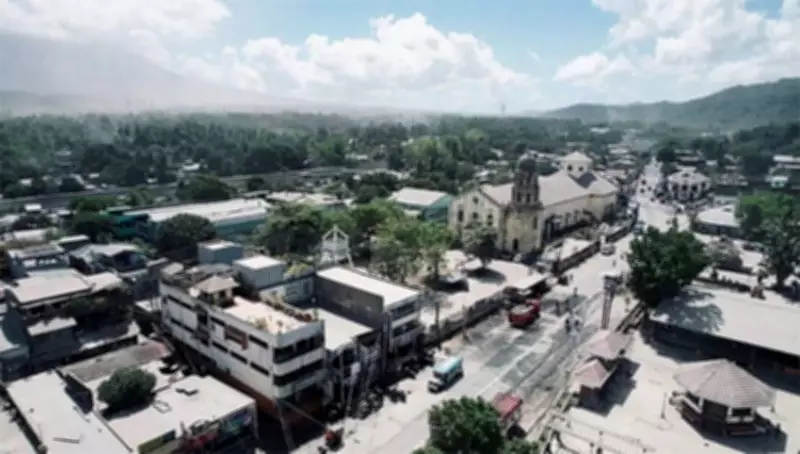
Albay – Thick ash has covered areas in Guinobatan, Albay, following ash emissions from Mayon Volcano, based on aerial photos shared by Mayor Ann Gemma Ongjoco. The National Disaster Risk Reduction and Management Council (NDRRMC) reported on Tuesday, May 5, 2026, that over 52,000 families have been affected by the ongoing unrest of Mayon Volcano.
Affected Population and Evacuation Efforts
The disaster council stated that a total of 52,590 families, or 199,367 persons, across 124 barangays in Albay have been impacted. Of these, 1,444 families (5,459 persons) are currently inside evacuation centers, while 26 families (85 persons) are receiving assistance outside evacuation centers.
Humanitarian Aid Distribution
The Department of Social Welfare and Development (DSWD) reported that over PHP 117 million worth of humanitarian assistance has been distributed. This includes food and non-food items, psychological interventions, cash-for-work programs, and emergency cash transfers. DSWD Assistant Secretary Irene Dumlao explained that the emergency cash transfer is an unconditional cash transfer amounting to more than PHP 10,000 per family to help cover other needs of internally displaced persons, such as basic supplies, milk for children, supplements, and other necessities.

Security Measures and Danger Zone Expansion
Philippine National Police (PNP) Chief General Jose Melencio Nartatez Jr. has ordered the mobilization of additional units to fortify the perimeter of Mayon Volcano. This follows reports that the current six-kilometer Permanent Danger Zone (PDZ) may soon be expanded to a seven-kilometer radius. Nartatez emphasized full coordination on the ground to prevent unauthorized entry into the danger zone, especially as restive conditions around Mayon continue to threaten nearby communities.
“The PNP is coordinating with our grassroots partners. We have established a direct communication line between our local police stations and the barangay intelligence networks. Our officers are conducting joint foot patrols with barangay tanods to ensure that every alley and back-trail leading into the six-kilometer PDZ are monitored,” he said.
Phivolcs Warning and Enforcement Challenges
The Philippine Institute of Volcanology and Seismology (Phivolcs) earlier warned that Mayon’s activity could escalate, prompting discussions to widen the current six-kilometer PDZ to seven kilometers. The expansion would cover more villages already under evacuation, raising concerns over residents attempting to return to tend farms or retrieve belongings. Nartatez noted that local knowledge remains a key factor in enforcement efforts, as some evacuees seek to quietly slip back into restricted areas.
“We rely on the local knowledge of barangay officials to identify residents who might be tempted to slip back into their homes, and we are integrating their real-time reports into our deployment shifts,” he said.
Ongoing Patrols and Checkpoints
Police units on the ground have been ordered to sustain round-the-clock checkpoint operations and increase visibility in entry points leading to the slopes of Mayon. Patrols have been intensified both on foot and through mobile units, with aerial monitoring considered for remote paths. Nartatez stated that ground commanders have been given a clear directive to exercise maximum tolerance but maintain zero compromise on the 'No Entry' policy.
“If residents are caught entering for farming, we will assist them in returning to the evacuation centers while explaining the immediate life-threatening risks of pyroclastic density currents,” Nartatez said. “However, for tourists or individuals who deliberately disregard the cordons for sightseeing, we will not hesitate to escort them out and coordinate with the LGU for the filing of appropriate administrative charges or penalties,” he added.