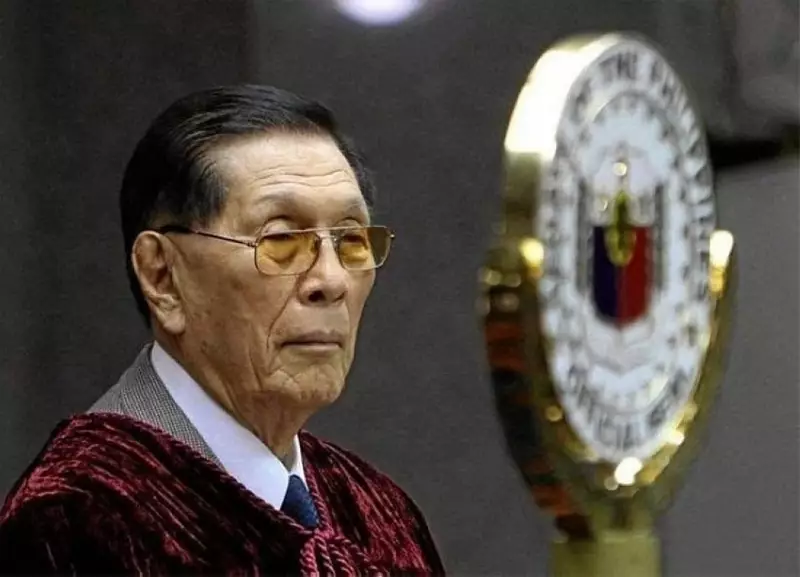
Several human rights organizations have strongly denounced the scheduled burial of former senator and chief presidential legal counsel Juan Ponce Enrile at the Libingan ng mga Bayani on Saturday, November 22, 2025.
Strong Opposition from Victims' Groups
Fides Lim, spokesperson of Kapatid-Families and Friends of Political Prisoners, expressed deep concern about the decision. "What should have been hallowed ground has long been demeaned and dirtied by liars and thieves," Lim stated. She questioned the nation's ability to distinguish between genuine heroes and those who caused suffering during authoritarian regimes.
Attorney and activist Aaron Pedrosa described the hero's burial as an act of "historical whitewashing" and noted that the cemetery had already been compromised by the burial of Ferdinand Marcos Sr. in 2016. "Surely, there is room for the late strongman's criminal co-conspirator and architect of martial law," Pedrosa remarked sarcastically.

Martial Law Legacy Under Scrutiny
Jon Ivan Torreros, vice president for Visayas at the National Union of Students of the Philippines, called the decision "a shame to the Philippine government." He emphasized that Enrile should not receive heroic honors given his involvement in human rights violations during the martial law period.
Bonifacio Ilagan, spokesperson of Selda, provided disturbing statistics about the martial law era under Enrile's watch. "Up to 70,000 persons were arrested without warrant and detained without charges. Some 35,000 were tortured, more than 3,000 killed extrajudicially and at least 700 forcibly disappeared," Ilagan revealed in his November 21 statement.
Ilagan further noted that Enrile never expressed remorse for these atrocities and instead justified his role in Marcos' 14-year authoritarian rule.
Concerns About Historical Revisionism
Pastor and rights defender Irma Balaba described Enrile's burial as "a painful reminder of how easily our history can be distorted." She expressed concern that the decision risks rewriting collective memory and normalizing past abuses.
The National Union of Peoples' Lawyers echoed these sentiments, calling the burial part of a "project of historical rehabilitation." The group emphasized that this act represents an effort to confer honor on a former Defense Minister whose role in martial law cannot be separated from its atrocities and repression.
Enrile, who passed away on November 13 at age 101 after battling pneumonia, was the longest-serving Filipino public servant. His daughter, Katrina Ponce Enrile, remembered him as someone who "dedicated much of his life to the service of the Filipino people."
The Department of National Defense honored Enrile's memory, describing him as "an icon in defense policy and strategy" who played a foundational role in building the modern defense department. The DND has ordered flags flown at half-mast to honor his memory.
The Libingan ng mga Bayani, established in 1947, spans 103 hectares and originally served as a memorial for over 49,000 Filipino soldiers who died in World War II, along with other patriots, martyrs, presidents, and influential figures in Philippine history.