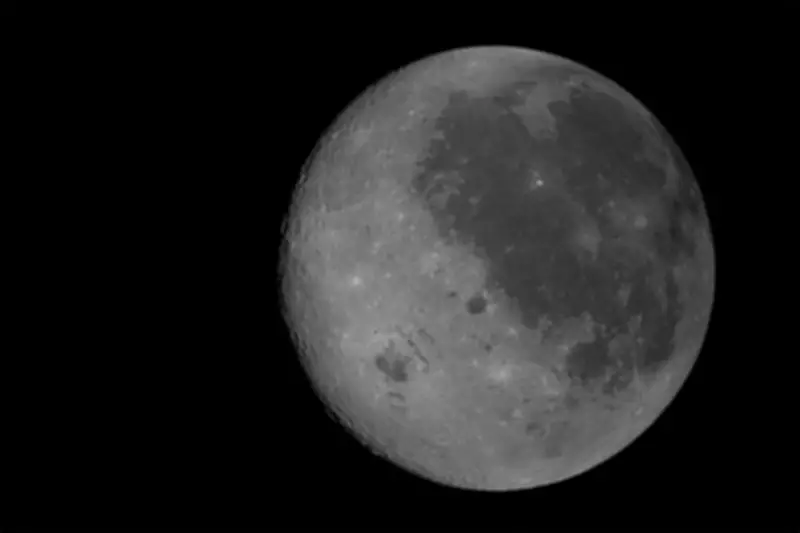
NASA's Artemis II Mission Unveils Rare Dual View of the Moon
In a groundbreaking update shared on its official social media pages on April 6, 2026, NASA has released a stunning image that captures both the near side and far side of the moon in a single frame. This rare visual achievement offers a unique perspective on Earth's celestial neighbor, highlighting distinct geological features that have long fascinated scientists and space enthusiasts alike.
Contrasting Lunar Landscapes Revealed
The near side of the moon, which is perpetually visible from Earth, is characterized by dark patches known as maria. These regions were formed by ancient volcanic activity billions of years ago, creating a textured and varied surface that has been studied extensively through telescopes and previous missions. In stark contrast, the far side of the moon appears more uniform in color and texture, with fewer surface variations due to its different geological history and lack of large maria.
Orientale Basin: A Key Feature Along the Boundary
Along the boundary between the near and far sides lies the Orientale Basin, a massive impact crater that spans nearly 600 miles across both hemispheres. This feature, which has now been fully observed by humans for the first time thanks to the Artemis II mission, provides critical insights into the moon's formation and impact history. The basin's size and structure make it a focal point for lunar research, offering clues about the early solar system's violent past.

Historic Lunar Flyby by Artemis II Astronauts
On the same day as the image release, the four astronauts of the Artemis II mission conducted a historic lunar flyby that lasted approximately seven hours. This event marks NASA's first astronaut close encounter with the moon in over 50 years, since the Apollo missions of the 1970s. The flyby allowed for detailed observations and data collection, paving the way for future manned missions and potential lunar exploration efforts.
The Artemis II mission represents a significant milestone in space exploration, combining advanced technology with human ingenuity to expand our understanding of the moon. As NASA continues to push the boundaries of what is possible, such achievements underscore the agency's commitment to exploring new frontiers and inspiring generations to come.