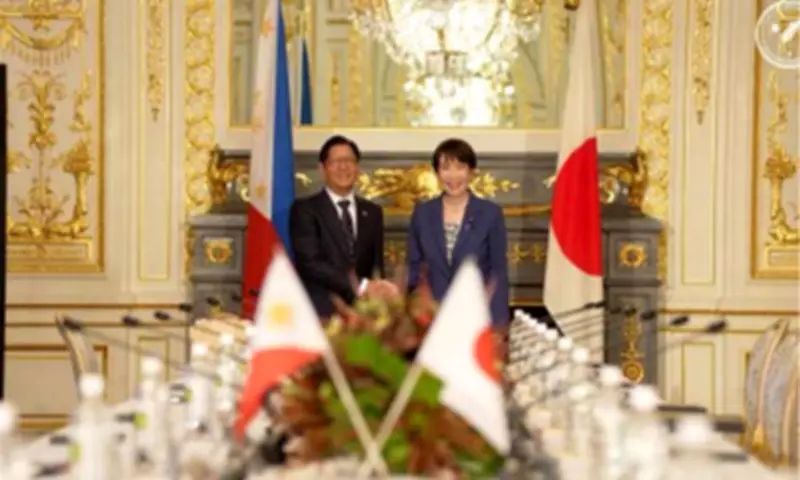
President Ferdinand R. Marcos Jr. and Japanese Prime Minister Sanae Takaichi have reaffirmed their commitment to transform the Luzon Economic Corridor (LEC) into a “world-class economic hub,” recognizing its strategic role in strengthening regional economic architecture and global supply chain resilience.
In a joint statement following a summit meeting in Tokyo, Japan on Thursday, the two leaders pledged to deepen cooperation on high-impact infrastructure and economic initiatives under the LEC framework. Priority areas include rail and port modernization, clean energy, semiconductor supply chains, digital connectivity, agribusiness, and civilian port upgrades.
“They also reaffirmed their strong commitment to transforming the LEC into a world-class economic hub that strengthens global supply chains, accelerates economic development, and delivers mutual economic prosperity,” the joint statement read.

The LEC is a trilateral initiative involving the Philippines, Japan, and the United States (US) aimed at enhancing connectivity and economic growth across Luzon, particularly along the Subic-Clark-Manila-Batangas corridor.
The Philippines and Japan acknowledged the importance of trilateral cooperation with the US and coordination with like-minded partners such as Australia and India in upholding a “free and open” international order based on the rule of law.
The two leaders emphasized that strengthening infrastructure connectivity and resilience through Japan’s Official Development Assistance (ODA) is vital not only to the Philippines’ economic growth but also to regional stability.
Japan reaffirmed its support for “high-quality, resilient, and sustainable infrastructure development” to help advance the Philippines’ economic and social transformation.
The two countries also agreed to deepen cooperation in economic security, including efforts to strengthen resilient and diversified supply chains in critical minerals, renewable energy, automotive manufacturing, and advanced technologies such as artificial intelligence (AI).
They likewise committed to enhancing collaboration on digital infrastructure, including undersea cables and 5G Open RAN technologies, while promoting secure and trustworthy AI ecosystems through the Japan-ASEAN Co-creation Initiative for AI.
On trade and investment, both sides stressed the importance of full implementation of existing agreements such as the Philippines-Japan Economic Partnership Agreement, the ASEAN-Japan Comprehensive Economic Partnership, and the Regional Comprehensive Economic Partnership.
Japan also expressed support for the Philippines’ planned accession to the Comprehensive Agreement for Trans-Pacific Partnership.
In the energy sector, the two leaders agreed to expand cooperation under the Asia Zero Emission Community, including on liquefied natural gas, offshore wind, and civilian nuclear energy, subject to developments on the Philippine side.