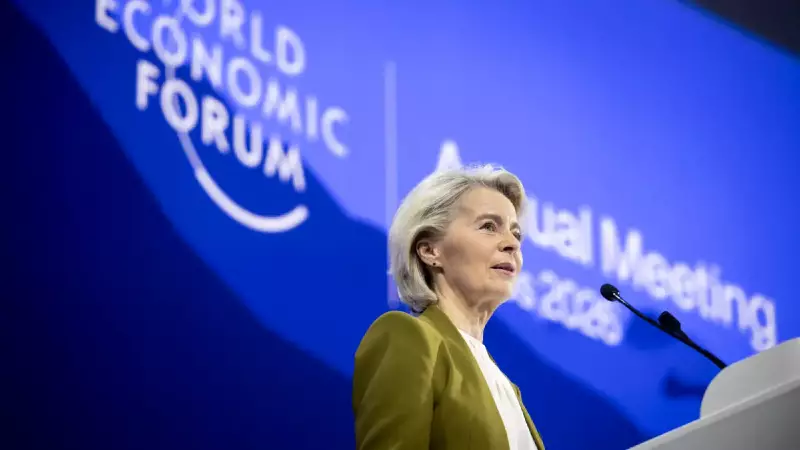
In a firm declaration at the World Economic Forum in Davos, Switzerland, European Commission President Ursula von der Leyen has committed to confronting the territorial threats made by U.S. President Donald Trump regarding Greenland. This statement, delivered on Tuesday local time, underscores the growing diplomatic strain between the United States and the European Union over the autonomous Danish territory.
Escalating Tensions Over Greenland
Von der Leyen emphasized that the intensifying dispute over Greenland could lead to a downward spiral in the longstanding alliance between the U.S. and the EU. She warned that this issue might severely damage bilateral relations, highlighting the gravity of the situation as European leaders express deep concern. The controversy stems from Trump's persistent interest in bringing Greenland under American control, a move that has sparked international alarm.
Trump's Provocative Actions and Statements
Adding fuel to the fire, Trump has threatened to impose additional tariffs on eight European countries in response to disagreements over Greenland. This has prompted the EU to consider potential retaliatory measures. In a provocative social media post on Truth Social, Trump shared an altered image depicting him planting a U.S. flag in a rocky, icy landscape with a sign reading GREENLAND – US TERRITORY EST. 2026, further escalating tensions.

Trump also mentioned having a productive phone conversation with NATO Secretary-General Mark Rutte about Greenland's mineral-rich resources and confirmed plans for a meeting with relevant parties in Davos. He expressed skepticism that European leaders would strongly oppose his proposal, stating, They can't protect it, which has only heightened anxieties across the continent.
European Union's Response and Emergency Measures
In response to the escalating crisis, EU leaders are scheduled to hold an emergency summit in Brussels on Thursday to discuss the Greenland issue. This urgent gathering aims to formulate a unified strategy to address Trump's ambitions and mitigate the potential fallout on transatlantic relations. The summit reflects the EU's determination to safeguard its interests and maintain stability in the face of geopolitical challenges.
The ongoing developments underscore a critical juncture in international diplomacy, with von der Leyen's stance signaling a robust European pushback against unilateral actions that threaten global alliances.