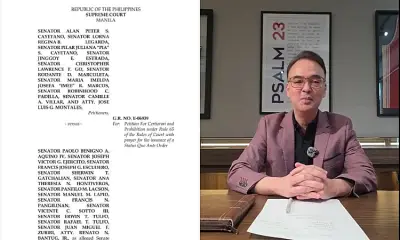
The Supreme Court of the Philippines has delivered a decisive and sobering intervention in the ongoing impeachment drama, issuing a ruling that fundamentally challenges the procedural shortcuts taken by political actors. The verdict, handed down on January 15, 2026, acts as a cold splash of reality, unsettling the political establishment and exposing deep flaws in how constitutional safeguards have been handled.
A Judicial Check on Political Expediency
The Court's ruling served as a powerful correction, stripping away the procedural veneer that had shrouded the earlier impeachment articles. It laid bare a troubling reality where political expediency had begun to erode the very scaffolding of the nation's constitutional order. The judiciary firmly asserted its role as the guardian of procedure, clarifying that due process must be observed at every single stage of an impeachment proceeding. This means constitutional protections cannot be cast aside or treated as optional, even when political pressure reaches a fever pitch.
This judicial move carries immediate and significant consequences for both the House of Representatives and the Senate. Political figures who genuinely seek accountability must now accept a fundamental truth: legitimacy is only achieved through meticulous adherence to the constitutional text and established legal precedent. Any deviation from this path will now likely face swift judicial correction and deepen public skepticism.

The Path Forward for Key Institutions
The ruling places specific demands on the country's governing bodies. For House members considering refiling impeachment complaints, the Court has set a clear bar. Any new complaint must respect the temporal limits identified by the justices and must present evidence that is clear and carries real probative value. The public will ultimately judge this effort not by its political theater, but by its strict fidelity to standards of proof and fairness.
For Senators who may one day sit as judges in an impeachment trial, the ruling is a call to prepare for a proceeding that tests the chamber's capacity to function as a true tribunal, not a partisan arena. The dignity and credibility of the Senate itself will depend on its ability to weigh facts dispassionately, protect the rights of the accused, and faithfully serve the public interest above political interests.
Broader Responsibilities in a Critical Moment
The Court's decision also outlines implicit duties for other sectors of society. Civil society groups and legal scholars are urged to insist on transparent procedures and the consistent application of evidentiary rules. Public confidence can only be rebuilt when hearings are designed to illuminate facts, not obscure them through procedural gamesmanship.
The Executive Branch, including the Presidency, is reminded of its duty to respect the separation of powers. It must refrain from any action that could be perceived as interference, upholding institutional integrity through measured statements and a refusal to inflame partisan tensions.
Similarly, media institutions bear a parallel responsibility to report with accuracy, avoiding the amplification of rumors as proof. The quality of public discourse improves when reporting is contextualized, and corroboration is prioritized over sensationalism.
A Defining Choice for the Republic's Future
This episode now stands as a critical test of the nation's civic courage and institutional fidelity. History will record the response. If lawmakers react with more haste and partisan calculation, the nation will be saddled with a dangerous precedent that rewards procedural manipulation and punishes sober, lawful inquiry. Conversely, if jurists and legislators collectively choose the path of rigor and restraint, the republic can reclaim a measure of moral authority and begin the slow work of restoring public trust.

The choice made in the wake of this Supreme Court ruling will shape the Philippines' political culture for a generation. The cost of failure is high: diminished rights, weakened checks and balances, and a citizenry that learns to expect political spectacle in place of genuine justice. The moment demands a collective reckoning on whether the republic will tolerate shortcuts that corrode civic trust and normalize impunity.