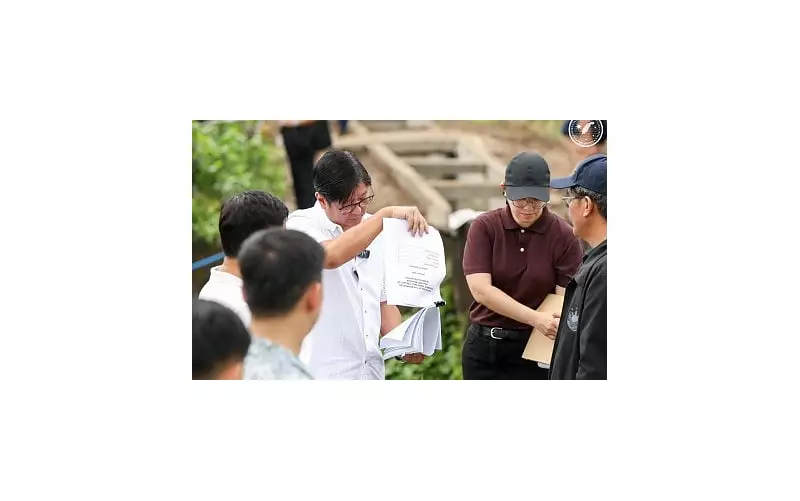
As 2025 concludes, President Ferdinand R. Marcos Jr. has made the integrity of flood control projects a central pillar of his administration's fight against corruption, emphasizing unprecedented transparency and strict accountability.
Budget Freeze and Fund Realignment
In a major fiscal decision, President Marcos ordered a halt to all new flood control allocations in the proposed 2026 national budget. This move came after the discovery that a significant portion of the PHP350 billion allocated for flood control in 2025 remained unspent, delayed, or incomplete.
"We already are seeing that all flood control projects that were supposed to be included in the 2026 budget may no longer be necessary. So, there will be no budget for 2026 for flood control because there is still PHP350 billion for 2025 that has not yet been fully utilized," Marcos stated in his September 8 podcast episode.

Following this, the President announced in September that funds originally earmarked for 2026 flood control would be redirected to other critical sectors. These include education, health, agriculture, housing, and social services, guided by a government "spending menu" to ensure prudent use of public resources.
Uncovering Irregularities and Strengthening Oversight
The administration's intensified scrutiny revealed concerning patterns in past flood control spending. On August 11, Marcos disclosed that an initial review showed PHP100 billion, or 20% of the total PHP545.64 billion spent since mid-2022, was awarded to just 15 contractors. This concentration raised serious questions about potential irregularities.
In response, Marcos directed the Department of Public Works and Highways (DPWH) to conduct a comprehensive review of recent projects and publish a list for public scrutiny. To institutionalize the probe, he signed Executive Order 94 on September 11, creating the Independent Commission for Infrastructure (ICI). This body is tasked with investigating anomalies in flood control and other infrastructure projects and recommending legal action.
By November 2025, the ICI had zeroed in on 80 flood control projects linked to flagged contractors, working with law enforcement to build cases.
Transparency Tools and Criminal Accountability
To empower citizen participation, the administration launched the "Sumbong sa Pangulo" website and a DPWH transparency portal on August 11. These platforms allow Filipinos to report anomalies, turning public scrutiny into a key tool for accountability. In November, the DPWH expanded its portal to show detailed project data—locations, budgets, contractors, and status—enabling real-time public monitoring.
The crackdown has moved from review to arrests. The year saw the filing of criminal cases and the arrest of several individuals, including controversial contractor Cezarah Rowena 'Sarah' Discaya. Charges filed before the Sandiganbayan and the Office of the Ombudsman include graft, malversation, and falsification against former lawmakers, DPWH officials, and private contractors.
"There will surely be more thrown behind bars in the New Year," warned Presidential Communications Office Acting Secretary Dave Gomez on December 27, highlighting the probe's shift to criminal accountability.
A Sustained Fight for Governance Reform
President Marcos has consistently stressed that cases must be built on solid evidence to secure convictions, balancing due process with the demand for justice. He maintains that properly built flood control infrastructure remains essential, but only projects meeting strict standards and with local government acceptance will be certified.
As the year ends, Malacañang reaffirmed that the battle is "far from over." Palace Press Officer Claire Castro emphasized on December 26 that the President's order is clear: "Managot ang lahat ng dapat managot (Hold accountable everyone who should be held accountable), whether they are relatives, friends, and allies."
The administration frames flood control not just as an infrastructure imperative but as a fundamental test of good governance, promising to continue the pursuit of integrity and fiscal prudence into 2026.