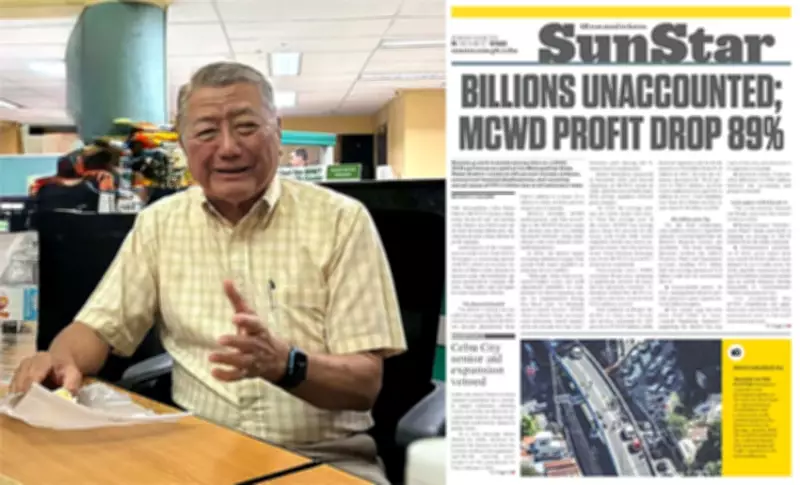
MCWD Financial Audit Confirms Catastrophic Income Decline Amid Political Turmoil
A comprehensive three-month financial audit conducted by the Metropolitan Cebu Water District's internal finance team has verified earlier alarming reports of severe financial deterioration at the utility provider. The audit findings, prominently featured in SunStar's April 15, 2026 front-page story by editor-in-chief Mildred V. Galarpe, substantiate claims made by MCWD Board Chairman Ruben Almendras regarding the organization's dire economic situation.
Staggering Financial Figures Revealed
The audit uncovered a devastating 89.42 percent collapse in MCWD's net income during 2024, plummeting from PHP 48.52 million to a mere PHP 5.13 million. These figures were officially confirmed by MCWD publicist and spokesperson Minerva Gerodias, lending authoritative weight to the financial assessment. The audit examined three years of financial records, painting a grim picture of the water district's fiscal health.
These audit results align with earlier reports from Chairman Almendras published in News+One on January 14 and February 4, 2026, where he warned that "MCWD is losing immensely and on negative cash flows." Almendras detailed how revenue consistently fell below water production costs, eliminating any profit margin. He quantified the daily losses at PHP 6.5 million, with approximately 30 percent of water production wasted as non-revenue water. For 2025 alone, Almendras reported total losses reaching PHP 765 million alongside a negative cash flow of PHP 342 million.

Root Causes: Political Battles Versus Mismanagement
The critical question emerging from this financial crisis centers on identifying primary causes to implement effective solutions. The audit report, according to Galarpe's coverage, attributes the income decline to "a timing mismatch between rising operational costs and delayed water tariff adjustments." Essentially, MCWD has been selling water at prices substantially below production or purchase costs, creating an unsustainable business model.
However, Chairman Almendras presents a different perspective, pointing directly to "mismanagement and corruption" as fundamental problems. In a News+One interview on January 14, he highlighted a concerning lack of transparency within MCWD that allowed systemic issues to fester undetected for five to six years. Almendras alleged that financial records had been "massaged" to conceal the true extent of problems, though Wednesday's audit story did not specifically address doctored reports.
This mismanagement accusation finds support from other prominent figures. In August 2025, Vice Mayor Tomas Osmeña characterized the MCWD situation as "a very serious situation" involving "mismanagement and anomalies," though other concerns have since diverted his attention.
The Destructive Impact of Political-Legal Conflicts
Almendras identifies the prolonged "political and legal fight" spanning 2023 through 2025 as a major contributor to MCWD's current crisis. This intense squabble between former board chairman Jose Daluz III and Mayor Mike Rama created organizational paralysis that severely hampered operations.
The conflict worsened due to disputes over authority to dismiss board members, resulting in insufficient directors to form a quorum. Compounding this dysfunction were contradictory rulings and opinions from various entities including the court system, City Hall, the Local Water Utilities Administration (LWUA), and the solicitor general's office, along with a failed LWUA takeover attempt.
Almendras himself represents part of the solution to this leadership vacuum. Appointed as a civic sector director by Mayor Nestor Archival on December 15, 2025, he was elected board chairman on January 29, 2026. With eleven years of prior MCWD board experience (1993-2004), including nine as chairman, Almendras brought valuable institutional knowledge. He acknowledged that "it took some effort" from Mayor Archival and Vice Mayor Osmeña to restore him along with two other directors to the previously paralyzed board that governs MCWD alongside the general manager.

Oversight Failure Ruled Out as Contributing Factor
When questioned about whether oversight failure allowed corruption and mismanagement to flourish unchecked, Almendras firmly dismissed this possibility. "Not a factor," he stated unequivocally on Wednesday, reiterating that "corruption and mismanagement" alone explain the crisis. He acknowledged that MCWD employs "many good and competent officers and staff," but suggested some may have "succumbed to the usual government kickbacks and SOPs, which may have reached the department level."
Significantly, Almendras explicitly ruled out as a contributing factor the legal provision blocking elected officials from interfering with water district operations nationwide. This clarification distinguishes political interference from the political-legal battles he cites as problematic.
The MCWD financial crisis represents a complex intersection of operational inefficiencies, alleged corruption, and debilitating political conflicts that have brought one of Cebu's essential utilities to a precarious financial position requiring immediate and comprehensive intervention.