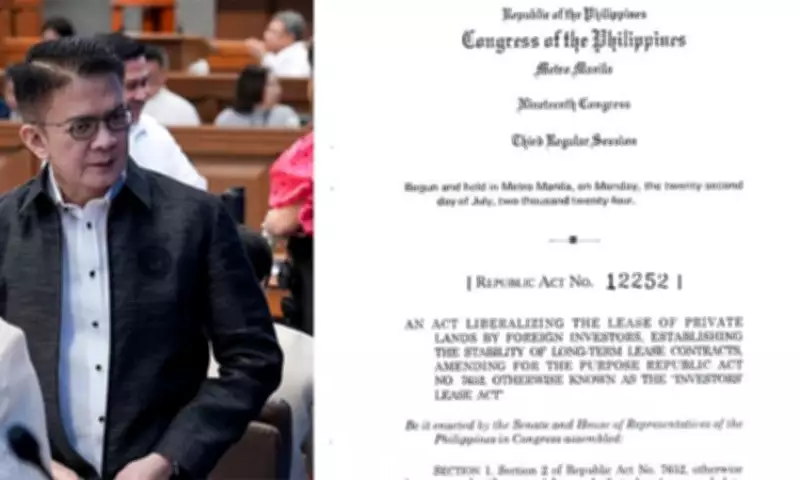
Senator Escudero Advocates for Aggressive Promotion of 99-Year Lease Law to Revitalize Philippine Economy
Senator Francis "Chiz" Escudero is strongly urging the national government to launch an aggressive marketing campaign for the new 99-year lease terms established under Republic Act No. 12252. He asserts that this legislative measure must be strategically positioned as a long-term anchor for job creation, capital infusion, and sustainable development across the nation.
Economic Slowdown Highlights Urgent Need for Investor Confidence
Escudero issued this critical call to action as the Philippine economy expanded by a mere 4.4 percent in 2025. This growth figure falls significantly below the government's target range of 5.5 to 6.5 percent and marks a deceleration from the 5.5 percent growth recorded in 2024. The senator warned that the country must actively compensate for this weaker economic performance by strengthening investor confidence and accelerating the implementation of structural reforms.
"The law is already in place. What we need now is aggressive promotion and clear messaging to investors that the Philippines is ready for long-term partnerships," Escudero emphasized.

Declining FDI and Persistent Unemployment Underscore Challenges
The veteran legislator highlighted that foreign direct investment inflows continue to soften, underscoring the pressing urgency of attracting long-term capital. Latest available data reveals that FDI net inflows reached only approximately $7.1 billion from January to November 2025. This represents a significant decline from the $9.08 billion recorded during the same period in 2024.
Escudero explained that this contraction, driven by weaker intercompany borrowings and a more cautious global economic sentiment, signals that the Philippines must move decisively to restore investor confidence and compete more aggressively for capital within the Southeast Asian region.
Furthermore, the senator added that the domestic labor market remains fragile. The unemployment rate held steady at 4.4 percent in December 2025, which is equivalent to approximately 2.26 million jobless Filipinos. Youth unemployment also persists in double digits, reflecting ongoing structural challenges in effective job creation.
Escudero stressed that without stronger investment inflows, particularly into sectors that require substantial, long-term capital commitments, the country risks prolonging underemployment and missing crucial opportunities to absorb its rapidly growing young workforce. He emphasized that reforms like RA 12252 can help reverse these negative trends by encouraging investors to commit to projects that generate stable, high-quality employment over decades.
Key Agencies and Sectors Poised for Long-Term Growth
The Bicolano senator pointed to agencies such as the Philippine Economic Zone Authority and the Subic Bay Metropolitan Authority as key drivers in marketing ecozones and tourism hubs as prime, long-term destinations for capital, jobs, and innovation. PEZA alone approved a substantial P260 billion in investments during 2025, while SBMA continues to successfully attract logistics, manufacturing, and tourism projects that inherently require long-gestation capital.
"In times of economic slowdown, we must think in centuries, not quarters. RA 12252 ensures that those who invest here will stay for generations, creating a stability that outlasts temporary economic headwinds," he added.
Structural Reform Provides Certainty for Vital Industries
Escudero emphasized that RA 12252, which amends RA 7652 or the Investor's Lease Act, extends land leases for foreign investors from 50 years to 99 years. He described this as a pivotal structural reform that can help cushion the impact of weaker growth and provide much-needed certainty for long-term, capital-intensive projects.
He noted that specific sectors such as ecozones, tourism, renewable energy, and agribusiness stand to benefit most from these extended lease terms. These industries typically require heavy upfront capital investment and have long gestation periods, making the assurance of a 99-year lease a decisive factor in final investment decisions.

As the law's principal author, Escudero concluded that essential reforms must continue unabated even when economic growth slows. "We cannot pause structural change because of short-term numbers. On the contrary, we must push harder so that the next cycle of growth is stronger and more resilient," he definitively explained.