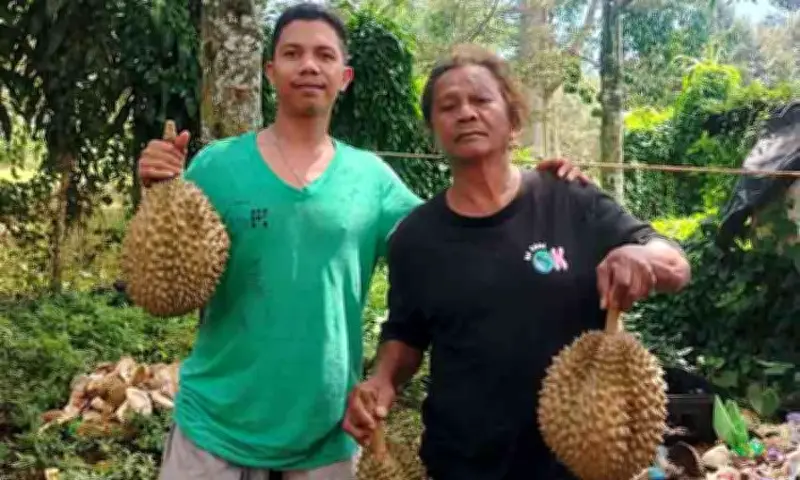
In Barangay Tamayong, Calinan, Davao City, 63-year-old Ricardo Anta Sr. walks beneath nearly 150 durian trees on his almost two-hectare farm every sunrise. He inspects branches heavy with Puyat, D101, and other export varieties. Nearly four decades ago, these hills were dominated by native durians, before hybrid varieties transformed Davao's orchards and carried the city's famed king of fruits to international markets.
A Life Built on Patience
Ricardo chose durian over his parents' crops of bananas, coffee, mangoes, marang, and avocado. "My parents were farmers too, but they grew different crops. I decided to grow durian instead," he said in the vernacular. That decision connected his family to Davao City's rise as the country's durian capital and an increasingly important supplier to China's growing market.
Success did not come quickly. Ricardo waited at least five years before his trees produced a commercial harvest. While waiting, he drove a motorcycle for hire, planted corn, jackfruit, avocado, and vegetables, and bought durian from neighboring growers to support his family. "Before our own trees began producing, I'd buy durian from other farmers and take it to Magsaysay Park to sell," Ricardo said. "At the time, farmers sold durian for only ₱15 to ₱20 a kilo. We were lucky if we could sell it for ₱30."

Struggles in the Early Years
In the early 1990s, durian remained largely a local delicacy. Buyers were few, and harvests often exceeded demand. "There were times the fruit simply rotted because no one was buying," Ricardo said. "It was painful to watch." Getting the fruit to market was another challenge. The dirt road connecting their farm to the highway was little more than mud and deep ruts. During the rainy season, Ricardo and other farmers hauled baskets by hand or relied on carabaos to pull their harvest out. "The farm is about one and a half kilometers from the road," he said. "Sometimes it took us until noon just to bring everything out. We endured because we had no choice."
The Next Generation Steps In
Ricardo's son, GR, grew up watching those sacrifices. Long before he could drive, GR accompanied his father to markets and later rode jeepneys alone, carrying one or two large baskets of ripe durian to Bankerohan, where family friends watched over him while he sold the fruit. "I was still very young," GR recalled. "But every basket was sold." The lessons of hard work, trust, and patience came early. "When you plant durian, you cannot neglect it," Ricardo said. "You clean around the trees, fertilize them, spray against pests, and prune the branches. If you plant and walk away, the tree will die. You have to care for it like a child."
Seeds of Change
As Davao's durian industry evolved, Ricardo adapted. The Department of Agriculture provided seedlings, fertilizer assistance, and technical training as hybrid varieties took root. He attended seminars by the late Severino Belviz of Belviz Durian Farms, learning proper pruning, fertilization, and pest management. "We learned how to prune the trees, when to fertilize, and how to protect them from pests," he said. "If the fruit was deformed, we removed it so the healthy ones would grow better." Hybrid varieties such as Puyat, D101, and Cob gradually replaced many native trees, producing larger fruit and more consistent harvests. "I don't regret choosing durian," Ricardo said. "Everything my family has today came from these trees."
The industry's biggest turning point came when China opened its doors to fresh Philippine durian. Export companies like Maylong Enterprises Corporation began buying fruit for overseas markets, providing growers a steady stream of buyers. "There was a time when durian would rot because there were no buyers," Ricardo recalled. "Now, if one buyer can't take it, another can. Farmers no longer worry as much about where to sell."

Growing the Legacy
Today, GR Anta carries forward the family's legacy. After learning the trade as a boy selling durian in Bankerohan, he started farming on his own at 18. While helping manage his father's orchard in Tamayong, GR has established pockets of durian farms across Davao that supply exporters during harvest season. Two years ago, he expanded again, buying two hectares of land in Laak, Agusan del Sur, where hundreds of young durian trees are now taking root. Like his father nearly four decades earlier, GR now waits five to seven years for those trees to produce their first commercial harvest. During harvest season, he delivers one to three tons of durian almost every day to Maylong Enterprises, sourcing fruit from the family's orchards and neighboring growers. The steady demand has allowed him to build a home, buy a vehicle for hauling produce, and open a small neighborhood store. "My life really changed after the processing plants came," he said.
The Sweetest Harvest
Even as export markets flourish, farming still demands faith. Heavy rains can strip blossoms before they become fruit. Pests can ruin a promising harvest. Shifting weather patterns have altered flowering seasons. "Only God knows when we'll have a good harvest," GR said. Ricardo still walks his orchard every day, inspecting leaves, clearing weeds, and checking every tree. "You cannot neglect the trees," he said. "They depend on you." The orchard has become a living family album. Every tree tells a story of sacrifice. Every harvest recalls muddy roads and uncertain markets. And every fallen durian carries quiet victories—homes built one harvest at a time, debts slowly repaid, and children given opportunities their parents could only dream of. Today, GR hopes the same trees that sustained his family and cut short his own schooling will one day send his two young children to college, allowing them to finish the education that both he and Ricardo were forced to leave behind.
For consumers in China, Davao durian may simply be another premium fruit. For the Antas, every shipment represents a lifetime of sacrifice finally bearing fruit. Ricardo often laughs that after spending decades surrounded by the king of fruits, he hardly eats it anymore. "I get full just from smelling the durian," he joked. But the sweetest reward has never been the fruit itself. It is watching the six children he raised build better lives from the very trees he planted while wondering if they would ever bear fruit. Now, as GR nurtures orchards of his own and waits for another generation of trees to mature, the family's story continues to grow. By sunrise tomorrow, Ricardo Anta Sr. will once again walk beneath the same 150 trees he began planting nearly four decades ago. Some will be ready for harvest. Others will need more time. Much like the family that grew with them, their story was never about a single season. It was about believing that today's labor could become tomorrow's legacy. In Barangay Tamayong, every harvest is more than fruit falling from a tree. It is a season of stories—rooted in faith, cultivated by perseverance, and passed from one generation to the next.