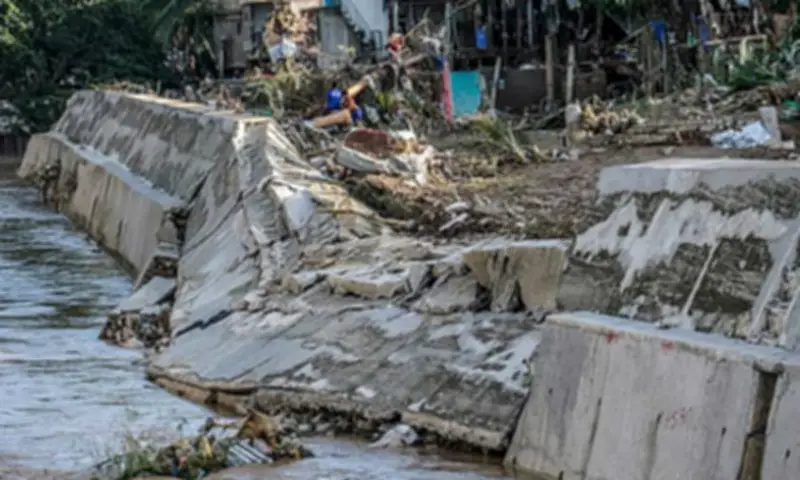
From 2016 to 2025, the Department of Public Works and Highways (DPWH) spent P4.3 billion on Cebu City flood-control projects, focusing primarily on downstream structural interventions like river walls, revetments, and drainage. However, major upstream interventions recommended in the Metro Cebu Integrated Flood and Drainage System Master Plan—including the construction of the Mananga, Butuanon, and Buhisan dams—remain unimplemented as of 2025.
Rise in Flood-Prone Areas
In a span of 23 years, from 1983 to 2006, the number of flood-prone areas in Cebu City rose sharply from 18 to 127 critical zones. To address what it described as “perennial flooding,” the Metro Cebu Integrated Flood and Drainage System Master Plan was developed. The plan proposed a multi-pillar strategy combining both structural and non-structural interventions.
However, a review of Cebu City’s P4.3-billion flood-control infrastructure projects from 2016 to 2025, funded by the DPWH, shows a heavy concentration on river walls, revetments, and drainage works. Several major upstream interventions identified in the master plan—including dams, detention facilities, and relocation programs—have yet to be implemented.

Focus on Revetments and Desilting
A review of DPWH project listings on its website and the “Sumbong sa Pangulo” portal shows that from 2016 to 2025, Cebu City’s flood-control spending largely fell under Organizational Outcome 2 (OO2) and Sustainable Infrastructure Projects Alleviating Gaps (Sipag). These programs focused mainly on structural interventions such as river-control structures, revetments, drainage improvements, and desilting operations.
Major allocations were concentrated on some of the city’s most flood-prone waterways. Along the Butuanon River, projects in Barangays Pulangbato, Sirao, and Binaliw reached nearly P80 million per phase. In 2024, a flood-control project in Barangay Bacayan-San Jose was awarded P144.6 million. The Guadalupe River system also received continuous funding for revetments in Barangays Guadalupe, Kalunasan, and Sambag. Large-scale desilting works were likewise implemented, including P95.1 million for the Butuanon River and P91.2 million for Tagunol Creek in 2021.
These projects provide immediate protection against riverbank erosion and help improve river flow in specific areas. However, the master plan envisioned a broader, integrated flood-management system that goes beyond downstream protection works. It estimated that comprehensive river improvements for the Central Cluster alone would require P18.47 billion, meaning current spending represents only a portion of the total structural interventions envisioned.
Missing Dams
A major gap between implemented projects and the master plan lies in the absence of large-scale upstream flood-control facilities. The plan stressed that river improvements alone would not be sufficient if runoff from upland areas continues to surge into waterways during heavy rainfall. It recommended several upstream interventions, including the Mananga Dam, a reservoir intended to store floodwaters affecting parts of Barangays Buot-Taop and Pardo; the Butuanon Dam, proposed about 2.5 kilometers upstream from Talamban Road to reduce downstream peak flows; and the rehabilitation of the Buhisan Dam to restore storage capacity lost to siltation.
Apart from these, flood and water-management expert Dr. Danilo Jaque of HydroNet Consultants proposed additional structures, including a 75-meter Mananga Dam capable of storing about 30 million cubic meters of water. He also recommended possible facilities such as a 30-meter Bulacao Dam (or a smaller 20-meter version), a 40-meter Butuanon Dam, and a 15- to 20-meter Budlaan Dam. These proposals remain subject to further feasibility studies.
Despite these recommendations, DPWH project records from 2016 to 2025 show no major dam construction contracts in these watersheds. Instead, funding has largely gone to downstream drainage and river-control projects in areas such as Tisa, Mambaling, and Basak San Nicolas. Jaque earlier said that without upstream storage and detention facilities—including a two-hectare retention area recommended for the Subangdaku catchment—downstream drainage systems remain vulnerable during heavy rainfall.

The proposed Mananga Dam has been discussed for decades but has not materialized due to funding requirements and the lack of a national government guarantee, based on earlier project discussions. SunStar Cebu sought comment from DPWH officials for more than a month regarding the implementation of the master plan and the absence of major dam projects. As of publication, no response had been received.
Relocation vs. Revetments
The master plan identified the removal of obstructions along waterways as essential to improving river capacity. It estimated that 4,326 houses in Cebu City (as of 2017) were located within the three-meter river easements. Cebu City’s Task Force Gubat sa Baha later identified at least 14,000 structures encroaching on these easements. In parts of the Guadalupe River, the master plan noted that settlements had reduced river width from the required 12 meters to as narrow as six meters.
To address this, the plan proposed a “No Demolition Without Relocation” policy, along with horizontal and vertical resettlement programs estimated at P2.8 billion to P3.8 billion for the Central Cluster covering Cebu, Mandaue, Talisay, Lapu-Lapu, and Cordova. However, records reviewed show that flood-control spending continued to prioritize structural works even in areas with documented river obstructions, including Mambaling and Duljo-Fatima. This raises questions on the pace and effectiveness of easement clearing and relocation efforts alongside ongoing infrastructure projects.
Alignment or Divergence
The review shows that DPWH has implemented several downstream measures identified in the master plan, including drainage improvements and riverbank protection works. These include large drainage projects along A. Gabuya St., such as Package 2 worth P96.3 million in 2025, and revetment works along portions of the Lahug River. However, major components of the integrated strategy—particularly watershed management, upstream flood-control facilities, and relocation of households along waterways—remain limited or absent in the reviewed projects.
A System Beyond Walls
Cebu City’s P4.3-billion flood-control spending has resulted in extensive river protection structures, but its implementation pattern differs from the broader system envisioned in the 2017 master plan. The plan warned that continued urbanization and increasing runoff could worsen flooding if watershed protection, river management, and non-structural measures are not addressed. The review suggests that while concrete structures have expanded along Cebu City’s waterways, questions remain on whether the full range of interventions—including upstream storage, watershed management, and relocation—has been fully implemented.