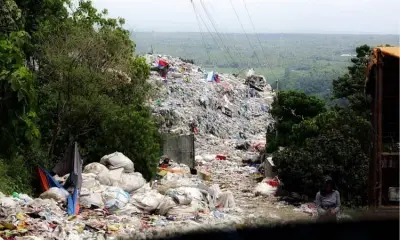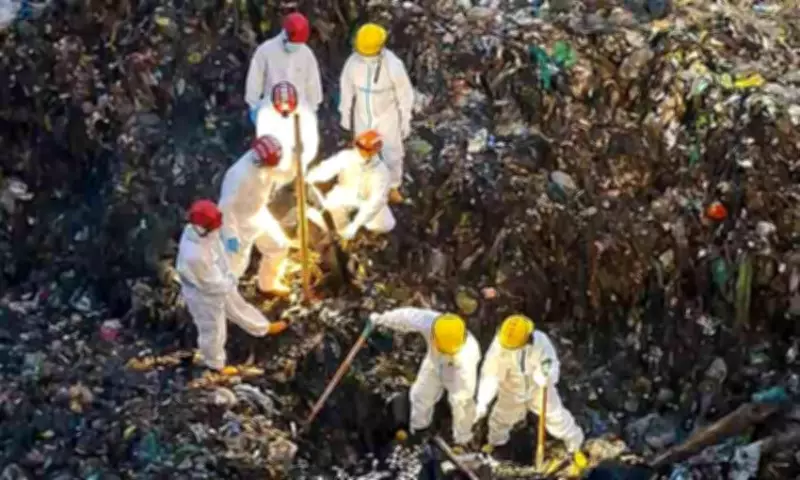
Authorities continue retrieval operations following a landslide involving a large volume of waste at the sanitary landfill in Barangay New Carmen, Tugbok District, Davao City, around 1:15 a.m. on May 20, 2026. The incident left one person dead, two others injured, and two still missing after a house was buried by the collapsed waste. The fatality was identified as Cristel, 32, a resident of Purok 8, Barangay New Carmen. The injured include a 16-year-old male and an adult female identified as Lilibeth, also from the area. The missing individuals were identified as Luisa, 78, and Rosita, 67, both residents of the same community.
Davao City Councilor Temujin “Tek” Ocampo encouraged Dabawenyos to segregate their waste as the city prepares to use a new sanitary landfill. Ocampo, chairperson of the committee on environment, said that the mass-wasting incident at the Davao Sanitary Landfill on May 20 was an “eye-opener” for everybody and that the public should start segregating their waste. “I think it’s high time. We call on the Department of Environment and Natural Resources now for us to really segregate our waste. Those that are biodegradable should just be buried if possible,” he said during the Pulong-Pulong sa Dabawenyos on May 26, 2026, at the Sangguniang Panlungsod.
Ocampo said he has always been campaigning for waste segregation, citing how the public could start segregating biodegradable, non-biodegradable, and recyclable waste. Under Republic Act 9003, otherwise known as the Ecological Solid Waste Management Act of 2000, there should be a comprehensive, sustainable solid waste management system that promotes waste segregation, recycling, composting, and proper disposal. Violators face fines of P1,000 to P3,000 or imprisonment for one to 15 days. On the local level, City Ordinance No. 0361-10, the Davao City Ecological Solid Waste Management Ordinance of 2009, mandates strict segregation at the source, regulates disposal, and prohibits littering and open burning, with penalties of P2,000 to P5,000 or imprisonment for one to 15 days.

Despite existing legislation, the waste reaching the landfill is mostly food waste, about 40 percent, fruit and vegetable residue at 23.79 percent, and food and kitchen waste at 18.48 percent. Ocampo also belied social media reports claiming a suspension of waste collection in the city. The posts alleged a temporary suspension for five to 10 days and issuance of citation tickets for improper garbage disposal. He said the city cannot cease operations since the amount of waste generated would be substantial. He assured Dabawenyos that waste collection continues and that the local government has coordinated with barangays and concerned agencies. The concern stemmed from multiple uncollected waste piles during regular collection, with large amounts left exposed, producing leachate and foul odors. However, Ocampo asked for public understanding regarding delays after the incident that claimed lives.
A mass-wasting incident occurred around 1:10 p.m. on May 20 at the Davao Sanitary Landfill in Barangay New Carmen. Rescue teams were deployed to search for those buried alive by the trash slide. With the current landfill still out of service, Davao City shifts to a new landfill site after the incident suspended operations at the New Carmen facility. The city acquired nine hectares adjacent to the current site; however, only 6.5 hectares will be used to meet the sanitary landfill development standards of the DENR. The new site costs about P500 million, with Phase One costing P340 million and Phase Two expected to cost around P200 million. Ocampo said the site has already been excavated and they are installing the lining, fast-tracking construction for immediate use.
Ocampo revealed that the city has complied with DENR requirements to operate the new dumpsite. Earlier, the city filed a motion for reconsideration on May 26 with DENR-Davao, citing geotechnical assessment results and recommended corrective measures. He said they allocated P34 million under Supplemental Budget No. 1 to comply with needed requirements for the current sanitary landfill, in line with measures to meet DENR standards.

Technologies to Help with Waste Reduction
Although the city has a new sanitary landfill adjacent to the current one, it still needs to explore technologies to reduce reliance on landfills. Ocampo said some companies have expressed interest in conducting a feasibility study on the current landfill to prevent incidents like trash slides. He also mentioned that the city obtained a legal opinion on a Memorandum of Understanding with a Malaysian-Singaporean firm specializing in waste-to-resource technologies, where all forms of garbage would be utilized. The Waste-to-Energy project has been floated as a solution, and Ocampo said they welcome it, waiting for a feasibility study from the Japanese government. He added that the local government is open to other players through Public-Private Partnership arrangements or any type of partnership benefiting the city.
Ocampo said they are reviewing proposals submitted to the city for long-term solutions to the waste problem. On the proposal to have three sanitary landfills, one for each district, Ocampo said this would be difficult considering that multiple areas in the city are protected areas and sources of water, which could heavily affect natural resources. On average, the Brgy. New Carmen landfill receives about 786 tons of waste per day and is nearing full capacity. The City Environment and Natural Resources Office reported that as of May 2025, the office had an average daily collection of 737 tons. In 2024, the average collection was 753 tons; in 2023, 746 tons; and in 2022, 782 tons.
Apart from new technologies, the materials recovery facility is one solution the city is looking into. Despite MRFs being a requirement under RA 9003 and City Ordinance No. 0361-10, only 53 out of 182 barangays in the city have MRFs while 116 have a materials recovery system. These facilities sort, process, and store biodegradable and recyclable materials and segregate plastics for the landfill. However, Ocampo said that although it is mandated by law for barangays to have their own MRF, some barangays do not have the space, especially those in the downtown area. He added that some barangays buy dump trucks and help in collection and segregation, while others seek other measures to improve waste management.
Relocation
Following the trash slide incident, Ocampo said that constructing houses near the sanitary landfill has always been prohibited. Based on the initial investigation, those who built houses in the area were not originally from Davao City. He said that those affected had already been evacuated and that the local government is looking for relocation sites based on requirements and whether they qualify for free housing. “Those who are not from there should really vacate the area, so we will only extend assistance to Davao residents who are living in that place and need to be relocated and provided with a safe place to stay,” he said. According to data furnished by authorities, 123 homeowners, six sharers, 374 dependents, one renter, and one boarder were evacuated to the gymnasium beside the Barangay Hall in Purok 3, New Carmen.