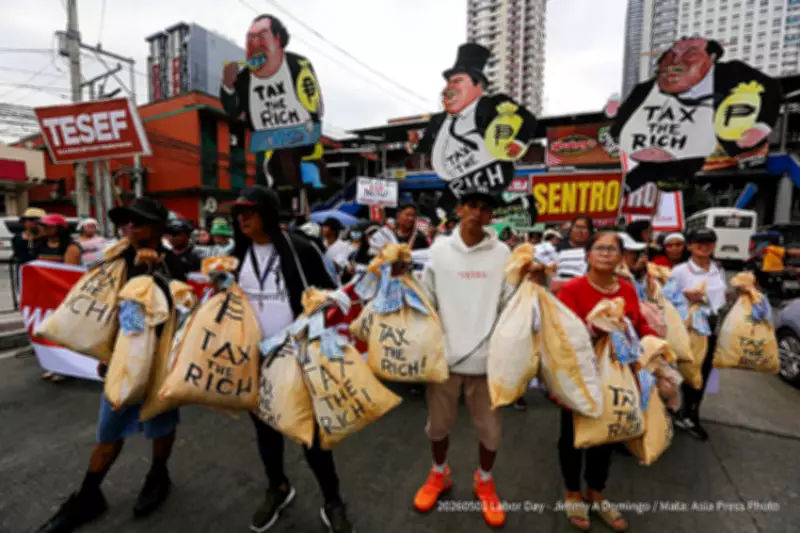
Various labor and rights groups in the Catholic-majority Philippines renewed calls to move beyond the tired, ritualistic calls for worker's action, demanding a wage hike and wealth tax as part of what they called a global fight against neoliberalism.
Wealth Tax as a Matter of Justice
Lidy Nacpil, coordinator of Asian People's Movement on Debt and Development (APMDD), told SunStar Philippines on Sunday, May 3, 2026, that a wealth tax is a matter of justice as well as fiscal necessity. She said a wealth tax could generate P502 billion and fully bankroll the Philippines’ national health budget or the Universal Health Care, resolve the classroom shortage, support public investment in renewable energy and grid modernization, or subsidize electricity rates for low-income households and food logistics at this time of spiraling fuel prices.
She added that extreme wealth means extreme emissions. Amidst climate disasters and economic crises, peoples of the Global South ask governments to make polluters pay and to tax billionaires, not workers.

For APMDD, a wealth tax is a cornerstone of the broader call for fiscal justice and the campaign to make taxes work for people and the planet. Nacpil emphasized that a wealth tax is both a matter of justice and a fiscal necessity without burdening the workers.
Ibon Foundation's Proposal
Sonny Africa, executive director of think-tank Ibon Foundation, reiterated support for a wealth tax on billionaires, a proposal the group first pushed in 2020. In March 2026, the foundation proposed that a wealth tax starting at one percent for wealth over P1 billion and rising progressively could generate up to P500-600 billion annually.
The top 10 percent of Filipinos held approximately P40 trillion in wealth as of 2022, nearly three times the P15 trillion net worth of the bottom 90 percent combined. The top one percent alone controlled P17.9 trillion, or roughly triple the P6 trillion net worth of the poorest half of the Philippine population, according to the Ibon Foundation in a March 2026 report. Forbes recently released its list of the world’s billionaires that included 11 Filipinos.
Workers Groups Join Global Struggles
Workers groups, including Sentro ng mga Nagkakaisa at Progresibong Manggagawa (Sentro) and the Labor Education and Research Network (Learn), also tied local demands to global struggles, arguing that a wealth tax will help correct the country’s seriously regressive tax system. They said that as with other places where neoliberal policies have taken effect, the middle and working classes shoulder the bulk of taxes while the ultra rich are able to escape their social obligation. The added revenue will also boost the capacity of the Philippine state to fund public programs, services, and eventually, serious plans for strategic economic sectors and industries.
They added that mobilizations must go beyond the annual political theatre and deliver systemic solutions to systemic problems.
Intolerable Wage Gap
Meanwhile, the Church People-Workers Solidarity, an ecumenical body composed of bishops, clergy, the religious men and women, lay leaders and workers, said the gap between wages and the real cost of living has become intolerable. The group said this is not merely an economic issue but a moral failure.
Citing the Ibon Foundation April 2026 data, the Family Living Wage in the National Capital Region (NCR) has reached P1,266 per day, while the minimum wage remains at P695, barely over half of what is required for a dignified human life. Along with this, the country’s unemployment has risen to 5.8 percent, the highest since 2022, with hundreds of thousands of new jobs being insecure, contractual, and short-term.
Work that strips dignity, denies stability, and withholds rightful benefits cannot be called just work. Workplaces continue to be sites of danger rather than dignity. Reports from the Institute for Occupational Health and Safety Development (IOHSAD) showed that in 2025 alone, at least one worker died each day due to preventable accidents. The ecumenical body called this unacceptable, stating that every worker’s life is sacred and no profit margin can justify unsafe conditions. To neglect safety is to disregard the God-given dignity of the human person.

Call for Official Salary Cuts
Bishop Gerardo Alminaza of San Carlos, the convener of civil society group Taumbayan Ayaw sa Magnanakaw at Abusado Network Alliance (Tama Na), maintained that amidst the current crisis and unresolved scandals of government corruption, top government officials should voluntarily reduce their salaries, allowances, and other perks. He said that no work, no pay should apply to officials too.
Fara Diva Gamalo, secretary of Freedom from Debt Coalition (FDC)-Eastern Visayas region chapter, urged workers and laboring masses to unite and dismantle unjust structures like policies and laws on contractualization and Republic Act 6715 (Wage Rationalization Act). She said workers are suffering so much from the multiple crises under the present economic condition. Instead of lifting them out of the situation, the government refused to suspend Excise and Value-Added taxation and went ahead for the one-time ayuda of a few thousand pesos.
Gamalo told SunStar Philippines that the government’s argument for not suspending Excise and Value Added Taxes are clearly not for the workers but favoring the elites and oligarchs. Today, workers must not only fight for their survival but fight for the dismantling of the current oppressive capitalist system that reinforces their poverty. According to FDC, the proposals for wealth tax legislation that is supposed to cushion the impact of the suspension of the excise and VAT taxes our lawmakers are not receptive.
As this developed, President Ferdinand Marcos Jr. recognized Filipino workers’ ability to adapt amid new technology and shifting industries. In his Labor Day message, he assured that the administration stands firm in defending the dignity of every Filipino by creating more and better jobs, boosting worker protection, and broadening pathways for all to succeed.