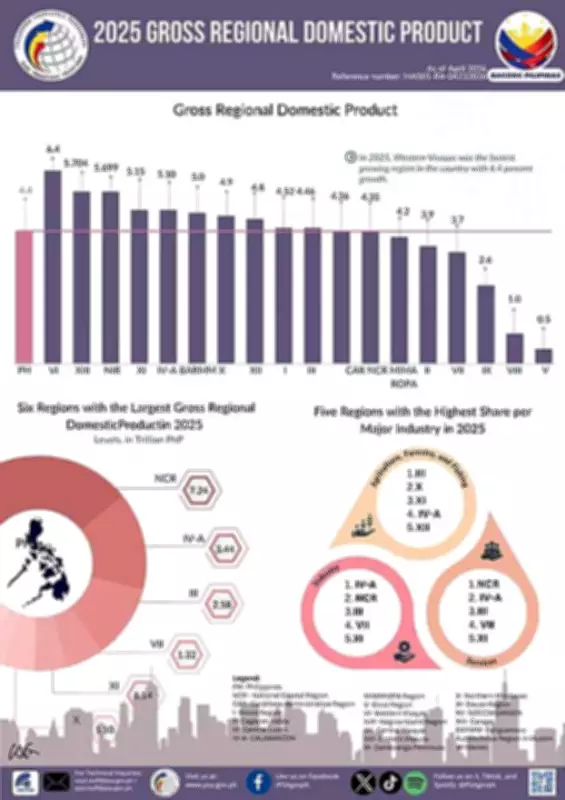
Central Visayas’ economic growth slowed to 3.7 percent in 2025, down from 7.3 percent in 2024, while Western Visayas overtook it as the country’s fastest-growing regional economy, according to the Philippine Statistics Authority (PSA). In a report released Thursday, April 24, 2026, the PSA said Caraga recorded the second-highest growth at 5.7 percent, followed by Negros Island Region at 5.7 percent. These regions — together with Davao Region, 5.15 percent; Calabarzon, 5.10 percent; Bangsamoro Autonomous Region in Muslim Mindanao, 5 percent; Northern Mindanao, 4.9 percent; Soccsksargen, 4.8 percent; Ilocos Region, 4.52 percent; and Central Luzon, 4.46 percent — exhibited higher growth rates than the national level growth rate of 4.40 percent.
Earlier this year, the PSA announced that the Philippine economy grew by 4.4 percent in 2025, slower than the 5.7 percent growth recorded in 2024. The data indicate that while momentum shifted, every administrative region maintained a positive trajectory throughout the year.
Central Visayas vs Western Visayas
In 2025, Western Visayas generally outpaced Central Visayas in terms of overall economic expansion, though Central Visayas held larger shares in specific national industries. Here is a detailed comparison of their performance:

Overall GDP Growth
Western Visayas recorded the fastest year-on-year economic growth rate in the entire country at 6.4 percent. In contrast, Central Visayas posted a slower growth rate of 3.7 percent.
Per Capita GDP
Western Visayas also led the nation with the highest per capita GDP growth rate at 5.7 percent, while Central Visayas recorded a growth of 2.7 percent.
Household Spending
Household final consumption expenditure grew faster in Western Visayas at 5.27 percent, compared to 3.87 percent in Central Visayas.
Government Spending
Both regions had relatively similar growth in government final consumption expenditure, with Western Visayas slightly ahead at 7.6 percent compared to Central Visayas at 7.52 percent.
Gross Capital Formation
Both regions experienced a contraction in gross capital formation; however, Western Visayas saw a much steeper decline of 11.4 percent, whereas Central Visayas declined by 3.9 percent.
Contributions to National Sectors
While Western Visayas had faster overall growth, Central Visayas contributed larger shares to the national economy in both the Services and Industry sectors.
- Services: Central Visayas accounted for 6.4 percent of the national services sector, which was more than double the 3.1 percent share of Western Visayas.
- Industry: Central Visayas held a 4.9 percent share of the total industry sector, surpassing the 1.93 percent share recorded by Western Visayas.
- Agriculture, Forestry, and Fishing: Western Visayas had a larger footprint in this sector, contributing 5.6 percent to the national total, compared to 3.4 percent from Central Visayas.
Performance of Key Industries
The industries with the fastest growth rates were human health and social work activities at 11.6 percent; education at 7.8 percent; public administration, defense and compulsory social security at 6.8 percent; transportation and storage at 6.7 percent; and other services at 6.6 percent, rounding out the top five industries. In 2024, human health and social work activities remained the top driver at 10.9 percent but education at 4.4 percent ranked 12th among the 16 categories ranked by the PSA.
The PSA report highlights a consistent upward trend across the archipelago, ensuring that no region was left behind during the 2025 fiscal period. This uniform growth suggests a stabilization of local markets despite the broader national slowdown compared to the previous year.
On the expenditure side, Government final consumption expenditure recorded the fastest growth at 8.4 percent. This was followed by Exports of goods and services to rest of the world at 8.2 percent. In terms of regional performance for Agriculture, forestry and fishing sector, Central Luzon had the largest share at 14.1 percent, followed by Northern Mindanao at 10.3 percent and Davao Region at 8.2 percent.

Development Outlook
Government analysts continue to monitor these figures to adjust regional development strategies. The focus remains on sustaining the high performance of social services and public administration to bolster local economies as they navigate shifting economic conditions.