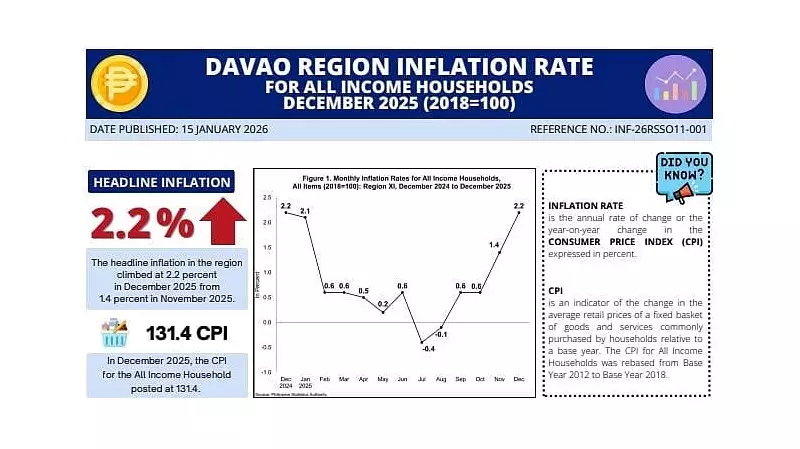
Families with the lowest incomes in the Davao Region felt a sharper pinch from rising prices as 2025 ended, with the cost of basic goods and services climbing at a quicker pace in December. The increase was primarily fueled by higher food prices, putting continued strain on tight household budgets.
Food Costs Drive Inflation Uptick
Data from the Philippine Statistics Authority (PSA) released on Thursday, January 16, 2026, revealed a significant acceleration in price increases for the bottom 30 percent of income earners in Region XI. Inflation for these households rose to 2.0 percent in December 2025, a notable jump from the 0.2 percent recorded in November. A year earlier, in December 2024, the rate was 1.1 percent.
The main culprit behind the December surge was the category of food and non-alcoholic beverages. After a decline of 1.8 percent in November, prices in this sector rebounded with a 1.8 percent increase. Specific items saw sharp rises:

- Prices for fish and other seafood leaped by 10.5 percent.
- Vegetables and similar food items became more expensive by 5.7 percent.
- Fruits and nuts also increased, posting a 0.9 percent rise.
A key exception was rice, where prices continued to provide some relief. Rice costs fell by 8.0 percent compared to December 2024, helping to moderate the overall food inflation figure.
Mixed Price Trends Across Other Essentials
Outside the food basket, the picture was varied. The cost of information and communication services, which includes mobile and internet plans, edged higher to 3.5 percent inflation from 3.3 percent.
However, some categories offered a reprieve for household spending. Significant slowdowns were recorded in:
- Housing, water, electricity, gas, and other fuels: Inflation cooled to 0.2 percent from 1.3 percent.
- Transportation: Price growth eased to 1.1 percent from 2.0 percent, reflecting more stable costs for fuel and fares.
Inflation for health-related expenses remained high but slowed slightly to 5.9 percent, while restaurant and accommodation services increased at a slower pace of 2.7 percent.
Inflation Varies Across Davao Provinces
The experience of rising prices was not uniform across the Davao Region. Davao City recorded an inflation rate of 2.7 percent in December, higher than the regional average. Davao del Sur posted the fastest increase at 3.9 percent, while Davao del Norte saw a 1.6 percent rise.
Other provinces experienced much milder price pressures. Davao de Oro logged a minimal 0.2 percent inflation, and Davao Occidental posted 1.1 percent. These differences highlight how local supply conditions and consumer spending patterns can lead to divergent economic experiences within the same region.
National Context and Impact on Families
The trend in Davao mirrored a national return of price pressures. For the bottom 30 percent of income households across the Philippines, inflation rose to 1.1 percent in December from 0.2 percent in November. Among the country's regions, Central Visayas had the highest inflation at 4.6 percent, while the Bangsamoro Autonomous Region in Muslim Mindanao posted a deflation of -1.2 percent. The Davao Region ranked among the higher-inflation areas, alongside Metro Manila and the Calabarzon region.
For low-income families, inflation directly erodes the purchasing power of the peso, forcing difficult choices at the market. While the December rate remains moderate compared to previous spikes, the rebound underscores the critical need for stable food supply chains and vigilant price monitoring as households navigate their finances in 2026.