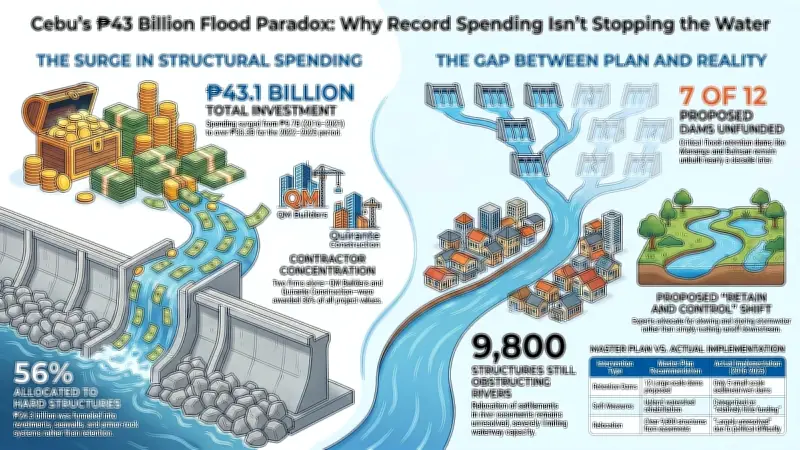
The province of Cebu spent more than P43 billion on 1,008 flood-control projects between 2016 and 2025, yet many critical interventions identified in a 2017 government master plan remain largely unimplemented, according to a SunStar Cebu investigation.
Spending Focused on Structural Works
A review of Department of Public Works and Highways (DPWH) records and the 2017 Metro Cebu Flood and Drainage System Master Plan reveals that over P24.3 billion was allocated to revetments, riverbank protection, seawalls, and slope stabilization. In contrast, upstream water-retention systems and watershed rehabilitation received relatively little funding, despite experts emphasizing their importance for reducing flood risk across entire river basins.
Flood-control spending surged dramatically over the decade. From 2016 to 2021, approximately P9.73 billion was recorded, but between 2022 and 2025, that figure jumped to over P33.38 billion. Major rivers like Mananga, Butuanon, and Cansaga received repeated funding for desilting and bank protection, while coastal municipalities in southwestern Cebu got billions for seawalls and storm-surge defenses. A massive budget spike occurred in 2023, with P13.92 billion for 209 projects focused on major river basins and strategic public facilities.

Master Plan Recommendations Largely Unfulfilled
The 2017 master plan warned that "flooding cannot be solved by isolated projects" and recommended integrated interventions, including detention basins, flood-control dams, watershed rehabilitation, stricter land-use regulation, relocation of structures from river easements, and a unified metropolitan flood-management body. However, SunStar found that many of these recommendations remain only partially implemented or unfunded.
The plan proposed at least 12 dams and mini-dams to slow runoff, but only five sabo and weir dams were constructed, with a combined value of P193.6 million. Key projects like the Mananga and Buhisan dams have yet to be funded. Detention basins in upstream areas such as Danao and Tuburan were also recommended but rarely built. Watershed rehabilitation remains limited, despite expert warnings that degraded upland forests exacerbate downstream flooding.
Relocation and Performance Gaps
The master plan identified approximately 9,800 structures occupying river easements in Metro Cebu, but relocation has been politically, financially, and socially difficult. As a result, many flood-control projects are built alongside waterways where settlements still constrict the channel. Additionally, neither DPWH nor local governments maintain a consolidated database showing whether projects reduced flood depths or duration, making it hard to assess actual risk reduction.
Residents in flood-prone communities report that flooding persists despite the spending. In Barangay T. Padilla, Cebu City, flooding now occurs during shorter heavy rains, while Villa del Rio in Barangay Bacayan experienced unprecedented flooding during typhoon Tino. Business owners in Mambaling and Subangdaku also say floods continue to disrupt operations.
Contractor Concentration and Government Response
SunStar found that a small group of contractors, including QM Builders and Quirante Construction Corp., accounted for about 36 percent of total flood-control spending, with combined projects worth P15.5 billion. While such concentration is not uncommon in large-scale infrastructure, observers say it warrants continued public scrutiny.
DPWH Region 7 Director Simon Arias and DPWH Secretary Vince Dizon did not grant interview requests from SunStar. Provincial officials acknowledged the need for stronger metropolitan coordination. Eleazar Sabinay of the Provincial Planning and Development Office said Governor Pamela Baricuatro supports reactivating a metropolitan coordinating body, and is working with the Office of the President to issue an executive order mandating oversight of metropolitan issues.
Looking Ahead
Nearly a decade after the master plan was completed, billions have been spent on flood-control infrastructure, but the most ambitious recommendations remain unfinished. As climate change intensifies rainfall and urbanization continues, experts say the key question is not how much is spent, but whether spending targets the interventions that will actually keep communities dry.