Cebu must urgently overhaul its approach to waste management to save the province from the "global polycrisis" before the 2030 international climate deadline, according to an environmental expert.
Speaking at a World Environment Day exhibition at the Cebu Provincial Capitol on Friday, June 5, 2026, Cherry Piquero-Ballescas, coordinator of the Regional Center of Expertise on Education for Sustainable Development, issued a warning for all. She emphasized that urgent and unified action from the government, citizens, and various sectors is the solution because the world is no longer facing separate or isolated challenges.
"It's a crisis now, a polycrisis, not a simultaneous one," Ballescas said. "It's really a multiplicity of crises. They have gone through the poor, they have gone through the hungry. And then you have your oil crisis, and then you have your Middle East. Then we have global warming," she added.

A polycrisis occurs when multiple global disruptions, such as climate change, geopolitical conflicts, economic inflation, and poverty, become interconnected and exacerbate each other. This results in overlapping emergencies that are more damaging than any single crisis. Ballescas noted that countries' compliance with the Paris Climate Agreement remains very low at 15 percent. Consequently, humanity has only four years left to prevent dangerous sea-level rise, intense typhoons, and extreme heat.
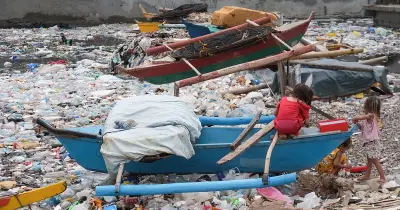
To address the waste problem that is part of this crisis, Ballescas proposed a local community dividend system for waste management instead of spending millions of pesos on collection and disposal in landfills, such as the one in Aloguinsan, or relying on waste-to-energy facilities.
Although Governor Pamela Baricuatro launched the "Clean Cebu Campaign" on March 19, a step to clean communities and improve waste management province-wide, there is still no concrete implementation on how to manage waste. Ballescas stressed the importance of cooperation and shared responsibility in tackling waste challenges.
She said that protecting the environment requires collective action and should not be left solely to government cleanup operations. Many people still view waste disposal as someone else's responsibility, a mindset that worsens environmental problems.
"Everybody is saying, 'This is not my problem. If I throw my waste, somebody else will pick it up for me,' but it is our problem," Ballescas said.
Ballescas called on media members to help spread environmental messages and educate the public about the importance of proper waste management and environmental preservation.