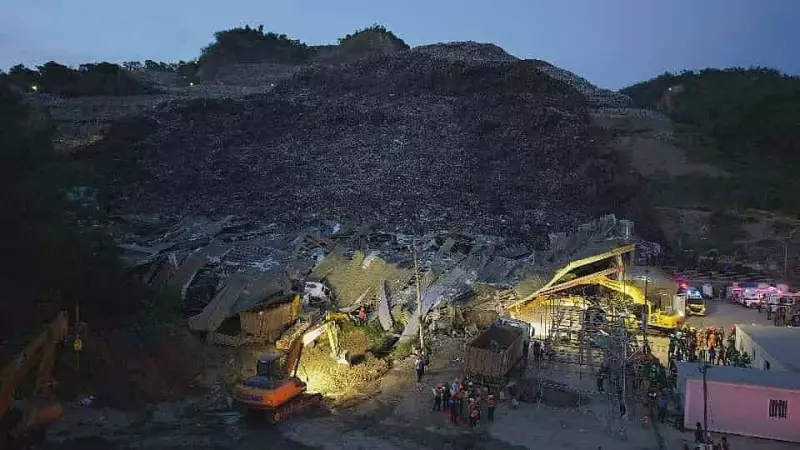
A devastating landslide at Cebu City's primary garbage dump has cast a long shadow over the region's most vibrant festival, revealing critical failures in environmental management and triggering a major urban logistics crisis.
Recovery Ends as Celebration Begins
In a somber coincidence, rescue teams retrieved the body of the 36th and final victim from the Binaliw landfill disaster early on the morning of January 18, 2026. The operation concluded just as the Sinulog Grand Showdown, Cebu's biggest cultural and religious festival, commenced with its themes of faith and unity.
The ten-day search and retrieval mission at the Prime Integrated Waste Solutions–Cebu facility in Barangay Binaliw was fraught with danger. Rescuers faced persistent risks from methane gas emissions and heavy rains while working in Quadrant A of the site. City Councilor Dave Tumulak confirmed the grim final count: 36 fatalities, 14 survivors discharged from hospital, and 4 individuals still receiving medical care.

A City Grapples with Immediate and Long-Term Fallout
The tragedy has forced Cebu City into an urgent and costly restructuring of its entire waste disposal system. With the Binaliw facility shut down by a cease and desist order from the Department of Environment and Natural Resources (DENR) 7, garbage trucks must now haul waste to distant landfills in Consolacion, Minglanilla, Pinamungajan, Toledo City, and Bogo City.
Mayor Nestor Archival highlighted the severe financial impact, noting that the increased hauling distance is straining the city's budget. "I don't think there is a problem with our tipping fee, but the problem is ang budget nato sa hauling because the disposal sites are farther," Archival stated. The city is seeking additional funding from the City Council to cover these rising costs.
The disaster has also delayed key environmental policies. The implementation of the strict "No segregation, no collection" policy, originally slated to begin soon, has been pushed back to March 2026 to allow for expanded public education campaigns.
Voices from the Aftermath
Local leaders framed the Sinulog festival as a time for healing and reflection. Governor Pamela Baricuatro urged the public to commit to protecting natural resources. Cebu Archbishop Emeritus Jose Palma spoke of resilience, pointing to recent floods and the landslide, but assured a "brighter tomorrow."
Mayor Archival addressed the pending investigation into the landfill's collapse, stating, "Now if there would be an investigation by the DENR, then mokuyog mi nila (we will join them)." He outlined a long-term goal to drastically reduce the volume of garbage sent to landfills to lower costs. In a telling moment, Archival also revealed he personally picked up litter during the festivities, saying, "Ako na lang namunit sa mga botelya (I ended up picking up the bottles myself)."
What Comes Next for Cebu
Clearing operations at the landslide site are expected to finish by Tuesday, January 20. Public attention now shifts to the DENR 7 probe into the landfill operator's alleged violations and the city's capacity to manage post-festival waste. Mayor Archival announced that future Sinulog celebrations will require participant contingents to have designated waste collection teams, signaling a new era of stricter event management born from tragedy.
Financial assistance continues for the families of victims, survivors, and displaced workers from the closed facility. Meanwhile, the landfill operator has proposed establishing a transfer station as a temporary solution, a plan awaiting DENR approval. The city's immediate waste is being directed to a temporary site in Consolacion under an arrangement valid until February 11.
This event marks another severe test for Cebu, following a series of earthquakes and typhoons, underscoring the urgent need for sustainable and safe urban environmental management.