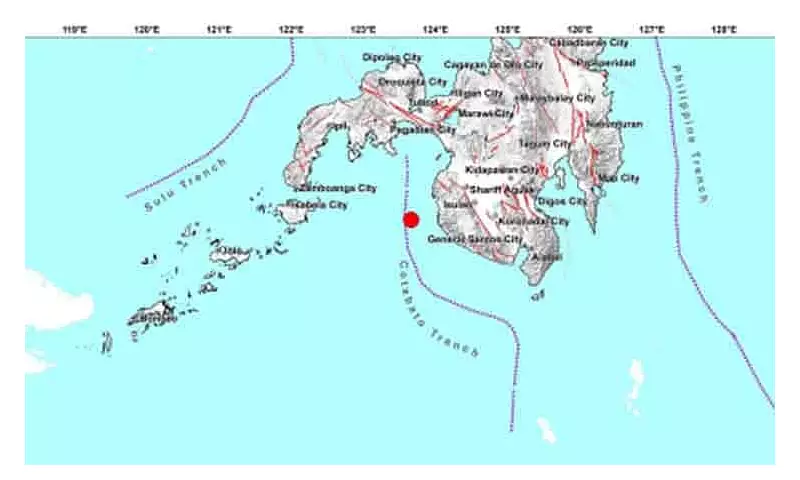
The Philippine Institute of Volcanology and Seismology (Phivolcs) has confirmed that the recent swarm of earthquakes shaking offshore areas of Sultan Kudarat is directly linked to tectonic movements along the Cotabato Trench. This major undersea fault system is known for its capacity to generate strong seismic events, raising concerns among residents and authorities.
Hundreds of Tremors Recorded in Sultan Kudarat
In an advisory issued on Thursday, January 22, 2026, Phivolcs reported that 633 offshore earthquakes had been recorded in Sultan Kudarat as of 12 noon. Of these, 197 earthquakes were plotted by seismic instruments, while 30 were felt by local residents. The earthquake swarm began on January 19, with magnitudes ranging from 1.4 to 5.2.
The strongest event was a magnitude 5.2 tectonic earthquake that struck at 9:33 a.m. at a depth of 10 kilometers. Phivolcs located the epicenter at 06.39°N, 123.72°E, approximately 40 kilometers south-southwest of Kalamansig, Sultan Kudarat. Instrumental intensity IV was recorded in Lebak, Sultan Kudarat, indicating moderate shaking.

Following the stronger shaking, precautionary measures were implemented across the province. Classes were suspended, and government work in three municipalities was halted to ensure public safety. In a subsequent update, Phivolcs noted that the number of recorded aftershocks had climbed to around 765 as of 6 a.m. on Friday, January 23, with magnitudes still ranging between 1.4 and 5.2.
Phivolcs Executive Director Explains Seismic Activity
Phivolcs Executive Director Dr. Teresito Bacolcol stated that the cluster of tremors was probably caused by the gradual release of stress along the Cotabato Trench. "The generator of these events is the Cotabato Trench," he emphasized in a message to a national news report. Bacolcol clarified that while the earthquakes are tectonic in origin, there are currently no clear signs that the swarm is a precursor to a larger earthquake, although such a possibility cannot be entirely ruled out.
The Cotabato Trench and Its Seismic Significance
The Cotabato Trench is a deep undersea trench located off the southwestern coast of Mindanao, stretching near Sultan Kudarat, Maguindanao, and South Cotabato. It is formed by the subduction of oceanic crust beneath the Philippine Mobile Belt, where tectonic plates converge and accumulate stress that is eventually released as earthquakes.
According to Phivolcs and international geophysical studies, the trench has been active for millions of years and is capable of producing moderate to large earthquakes, including megathrust events. Historical records and seismic research link the trench to destructive earthquakes such as:
- The 1918 Celebes Sea earthquake
- The 1976 Moro Gulf earthquake, which triggered a deadly tsunami
Scientists explain that earthquake swarms, like the one currently being observed, occur when stress is released gradually along sections of an active trench or fault, rather than through a single major rupture. These swarms can involve hundreds of small to moderate earthquakes over days or weeks and do not necessarily culminate in a stronger event.
Continuous Monitoring and Public Preparedness
Phivolcs emphasized that the Cotabato Trench remains a significant seismic and tsunami source, underscoring the importance of continuous monitoring, public preparedness, and adherence to safety advisories in coastal and nearby inland communities. The agency stated it will continue to closely monitor seismic activity in the area and urged the public to stay informed through official bulletins.
This ongoing seismic activity highlights the need for robust disaster risk reduction measures in vulnerable regions of the Philippines, particularly in areas adjacent to active tectonic boundaries like the Cotabato Trench.