Contrasting Disaster Responses: Odette's Swift Aid vs Tino's Cautious Help
When Typhoon Odette ravaged the Visayas and Mindanao in December 2021, the global community sprang into action within days. The catastrophic storm, recorded as 2021's most powerful typhoon, resulted in at least 400 fatalities and displaced hundreds of thousands of Filipinos, destroying entire communities and critical infrastructure.
The international response to Odette was both immediate and substantial. The European Union led the charge on December 20, allocating 1.7 million euros (approximately P96.4 million at that time) for essential needs including food, drinking water, shelter materials, and medical support. Canada followed swiftly, releasing around P120 million through partnerships with the World Food Programme, Oxfam Canada, Plan International, and the Red Cross.
By December 22, multiple nations had joined the relief effort. South Korea pledged $2 million in cash plus rice support, while China contributed $1 million and thousands of tons of rice. The United States provided an initial $200,000 in emergency relief, followed by an additional $1 million through USAID by December 27. Ireland, the United Kingdom, New Zealand, and Hungary also made significant financial commitments to assist devastated areas across Cebu, Surigao del Norte, and Southern Leyte.

Typhoon Tino's Different Reality: Measured International Response
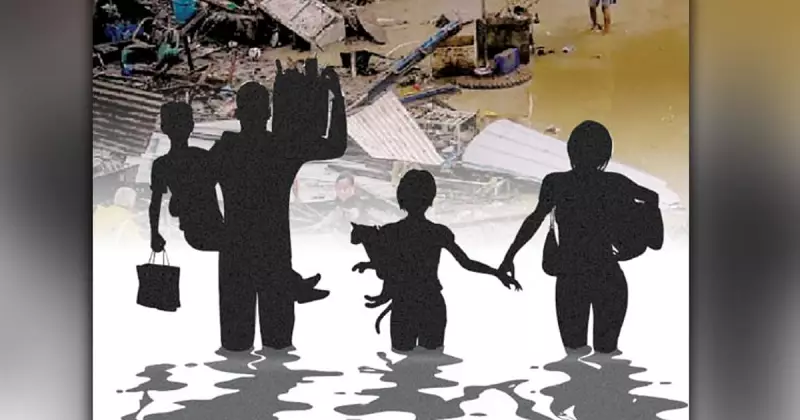
Fast forward to November 2025, and the scenario appears markedly different. Typhoon Tino made landfall on November 4, 2025, and while slightly less intense than Odette, has already claimed 224 lives as of Sunday, November 9. The devastation remains severe, with towns submerged, families stranded on rooftops, and widespread destruction of homes.
Despite images reminiscent of Odette's destruction, the international response has been notably more cautious. Four days after Tino's landfall, expressions of sympathy and offers to assist came from the United States, Canada, Australia, the United Kingdom, Spain, Japan, Russia, Saudi Arabia, Germany, the EU, and the United Arab Emirates. However, these initial statements lacked specific financial figures, delivery timelines, or confirmed humanitarian deployments.
The first concrete aid announcement came on Saturday, November 8, when the US government declared it was providing $1 million in immediate life-saving assistance to support relief and recovery operations in areas severely affected by Typhoon Tino and recent earthquakes.
Government Stance: No Formal Request for Foreign Assistance
According to Palace Press Officer Claire Castro, the Philippine government has not requested any foreign assistance following Typhoon Tino. "There has been no call for any foreign assistance because, as of now, we still have funds for situations like this," Castro stated during a November 7 briefing.
The National Government had already announced the release of P760 million in aid for typhoon Tino survivors in affected cities and provinces on November 6. Castro cited available quick response funds from frontline agencies and local government support funds from the Office of the President as sufficient for current needs.
The Philippine Department of Foreign Affairs has expressed gratitude for the numerous messages of solidarity and offers of support from the international community.
Changing Geopolitical Climate Affects Disaster Response
The current slower international response occurs against a backdrop of shifting geopolitical dynamics. Just two months before Typhoon Tino struck, South Korean President Lee Jae-myung suspended a P28.7 billion infrastructure loan to the Philippines, citing "potential for corruption." This decision emerged amid legislative investigations into alleged collusion in flood control projects—funds originally intended to prevent the type of flooding that now submerges parts of Cebu and the Visayas.

Despite the cautious initial response, some international assistance has begun to materialize. The EU has committed approximately P54 million for relief efforts connected to multiple typhoons this season, while the Singapore Red Cross pledged $50,000 for urgent medical and sanitation needs. Timor-Leste, ASEAN's newest member, has promised to send over 100 engineers and firefighters to assist in recovery and cleanup operations.
As disaster response experts emphasize, the critical window between impact and recovery determines survival rates. When homes lie buried in mud and evacuation centers overflow, time transforms into the most valuable currency for affected communities.