Southeast Asia could unlock its next major industrial and trade opportunity by treating waste as a strategic resource and building integrated regional recycling supply chains similar to the region's electronics manufacturing networks, according to sustainability investors and circular economy advocates.
Rethinking Cross-Border Waste Trade
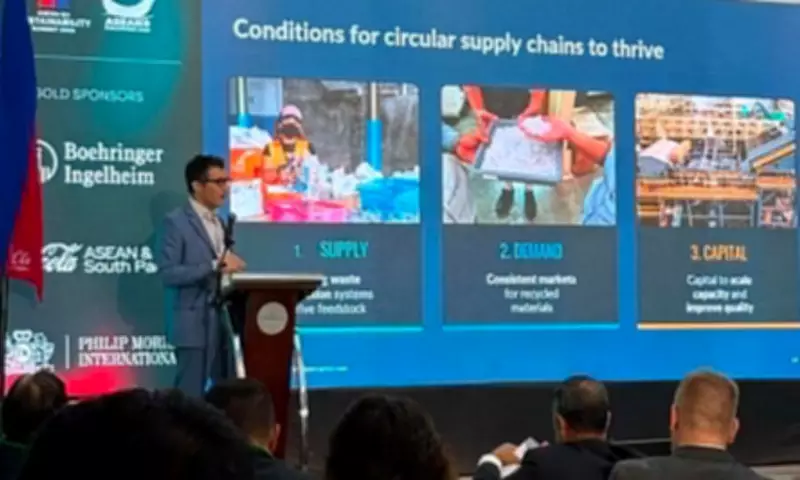
Speaking during a panel discussion on scaling Extended Producer Responsibility (EPR) systems in the Association of Southeast Asian Nations (ASEAN), Rob Kaplan, founder and chief executive officer of Circulate Capital, said ASEAN countries should rethink how waste and recyclable materials move across borders as industries face rising pressure to secure raw materials and reduce dependence on virgin resources.
"There is a perception that trade of waste and recycling is a bad thing," Kaplan said. "But actually one of the greatest strengths ASEAN has is to develop stronger regional supply chains where we're leveraging each other's resources — and waste is a resource, if we do it right."

Regional Integration for Economies of Scale
Kaplan noted that recycling systems built solely at the national level would be difficult to scale efficiently, particularly in developing economies where recycling infrastructure remains fragmented and uneven. Instead, he proposed a more integrated regional model where recyclable materials collected in one country could serve as feedstock for processing and manufacturing facilities in another.
"It's not just about the PET recycling of the Philippines," Kaplan said. "Combined with Malaysia and Indonesia, ASEAN could achieve something rivaling what India is doing."
The approach, he argued, could help ASEAN create economies of scale similar to the region's highly interconnected electronics and manufacturing supply chains.
Growing Investment in Circular Economy
The comments come as governments and companies across Southeast Asia ramp up investments in circular economy systems amid growing concerns over supply chain resilience, commodity price volatility and resource security. Industry leaders say recyclable materials such as plastics, metals and electronic waste are increasingly being viewed not simply as environmental liabilities but as alternative industrial inputs that could support manufacturing competitiveness and reduce import dependence.
The Philippines, one of the first ASEAN countries to implement mandatory EPR legislation, is already seeing rising recovery rates for plastic waste as companies exceed collection targets. However, government officials and businesses say the region still lacks sufficient recycling capacity, harmonized standards and policy alignment needed to fully develop cross-border circular supply chains.
Competition for Feedstock
During the forum, Antonio del Rosario, president of Coca-Cola Philippines, noted that local recycling facilities are beginning to compete for plastic feedstock as demand for recycled materials grows. Coca-Cola Philippines operates a bottle-to-bottle recycling facility in Cavite, but del Rosario said some recyclable plastics are still being exported because overseas buyers offer higher prices.
"We sometimes struggle with feedstock for our current plant alone," he said. "The plastics are in demand in other countries as well."
Policy Harmonization Efforts
Regional policymakers are now exploring ways to harmonize circular economy regulations, standards and waste management systems across ASEAN. Jonas Leones, undersecretary at the Department of Environment and Natural Resources, said ASEAN member states are discussing interoperability of policies, common standards and technology-sharing through regional working groups on plastic pollution and environmental sustainability.
The Philippines is also pushing for the adoption of the ASEAN Strategic Environmental Plan during its ASEAN chairmanship, aimed at strengthening regional cooperation on circular economy initiatives, recycling infrastructure and environmental standards.

Strategic Economic Asset
Sustainability experts say deeper regional integration could position ASEAN as a major global hub for recycled materials processing, much like its role in semiconductors and electronics assembly. Beyond environmental gains, the strategy could create new manufacturing industries, attract green investments and strengthen the region's ability to withstand future supply chain disruptions.
As industries worldwide race to secure critical materials and reduce carbon footprints, ASEAN's growing waste streams may increasingly be viewed less as a disposal problem and more as a strategic economic asset.