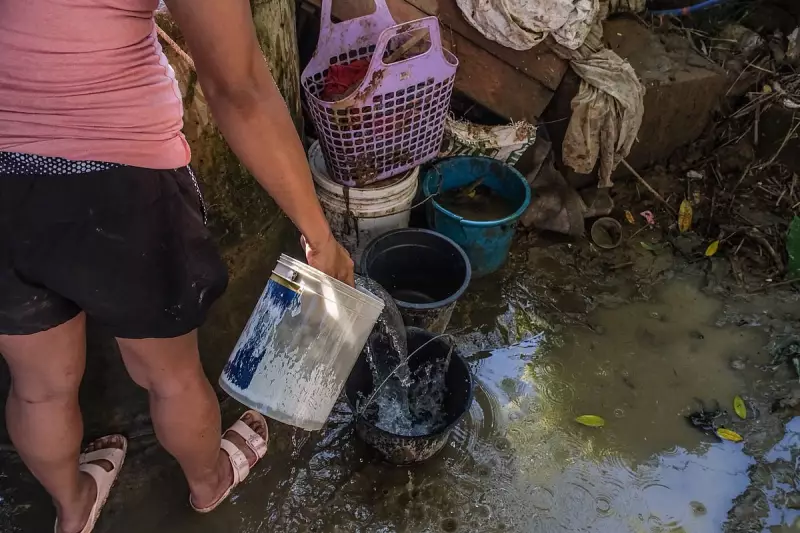
More than two weeks after Typhoon Tino ravaged Cebu Island, communities across Metro Cebu continue to face severe water shortages that are disrupting daily life and business operations.
Residents Resort to Alternative Water Sources
In Purok Mangga Uno, Barangay Cotcot, Liloan, residents have turned to a deep well for washing clothes and cleaning homes after water supply disappeared following the typhoon's November 4 impact.
The situation echoes across the region, with Narvie Borja, a student from Sitio Anapog in Barangay Lahug, Cebu City, forced to relocate to relatives in Carcar City due to the water shortage. Borja makes exhausting daily trips to Cebu City for classes while caring for her four younger siblings.

"If possible, the supply will return earlier than the promised date of Nov. 26," Borja shared via Messenger, referencing information she received from MCWD personnel.
Other residents describe creative survival strategies. Sai from Sitio Lumbang in Barangay Pulpogan, Consolacion, revealed her family has been without water for 14 days and now depends on a long hose connected to a neighbor's non-MCWD source, paying extra for the access and waking early to fill storage drums.
Businesses Suffer Operational Setbacks
Water-dependent enterprises are reporting significant financial losses and operational challenges due to the unstable supply.
Ariel Adanza, who operates both a water refilling station and laundry shop in Talisay City, continues to struggle with low water pressure hampering output. Another Talisay laundry business now requires customers to wait three to five days instead of the usual one-day service, with staff waking at 2 a.m. to monitor pressure and fill storage tanks.
Some businesses have been forced to close branches and outsource work to locations with better water access.
Carl Cabusas, president of the Talisay City Chamber of Commerce, confirmed that while most enterprises have reopened, they continue to face losses and operational setbacks from the water outages.
"Water supply remains a significant biggest challenge," Cabusas emphasized in a November 18 text message to SunStar Cebu.
MCWD Restoration Efforts and Challenges
As of November 18, the Metropolitan Cebu Water District has restored 76 percent of its total supply, producing 208,599 cubic meters of water compared to its usual 275,000 cubic meters capacity.
MCWD information officer Minerva Gerodias identified the primary obstacles as damage at the Jaclupan facility in Talisay City and the JE Hydro plant in the Lusaran reservoir in Cebu City, both of which remain non-operational.
MCWD plans to bypass the typical three-month repair timeline for the damaged Jaclupan pipe by installing a new pipeline from a different supplier to connect the Lagtang, Talisay, and Tisa, Cebu City reservoirs. Gerodias indicated supply from Jaclupan may resume by Thursday, November 20.
The Guizo area faces a separate crisis, with approximately 17,000 cubic meters of water offline due to flooding affecting a Compostela supplier and the collapse of a transmission pipe from a Consolacion supplier.
Communication Breakdown Frustrates Consumers
Residents report increasing frustration with MCWD's communication channels. Alex Bordiano of Tres de Abril Street in Cebu City said his area has had no water since November 10 and that MCWD has not responded to calls or messages.
Clariza Sevilla of Barangay Guizo, Mandaue City, described waiting on hold for two hours before her call dropped. She criticized MCWD's online responses as generic and questioned why the water district disabled comments on its Facebook page.
Gerodias explained that comments were disabled to direct consumers to Messenger, where concerns are more visible to customer service representatives. She acknowledged that high call volumes sometimes create queues, noting MCWD has fewer customer service staff compared to dedicated call centers.
In its latest advisory, MCWD reminded the public that unauthorized drilling, puncturing or altering its pipelines is illegal and may cause additional interruptions, water loss or contamination problems.