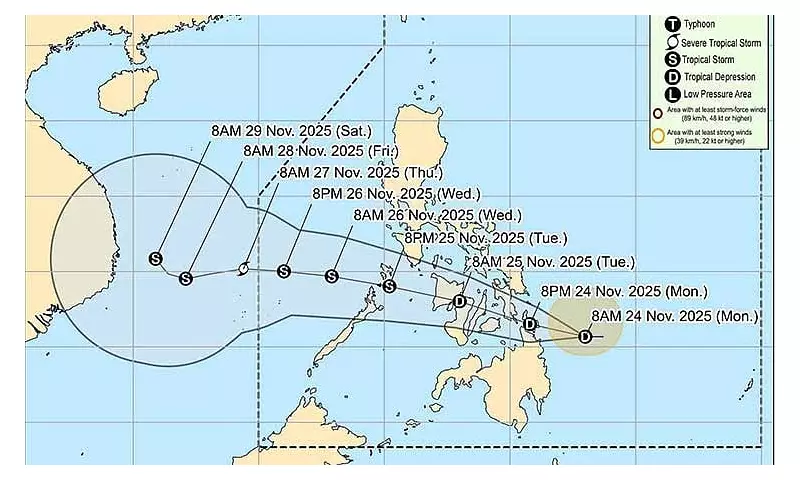
The state weather bureau PAGASA raised Tropical Cyclone Wind Signal No. 1 over several areas in Mindanao on Monday, November 24, 2025. This action came after a low-pressure area east of the region rapidly intensified into Tropical Depression Verbena, raising serious concerns about potential flooding and landslides.
Storm Details and Projected Path
PAGASA confirmed that the weather system developed into a tropical depression around 2 a.m. on November 24, 2025. As of its 5 a.m. advisory, Verbena was located approximately 330 kilometers east of Surigao City, Surigao del Norte.
The tropical depression is moving westward at a speed of 30 kilometers per hour. It packs maximum sustained winds of 45 kph and gusts reaching up to 55 kph. Pagasa forecasts that Verbena will make landfall over northeastern Mindanao on the afternoon of November 24. The weather system is not expected to intensify further and will likely remain a tropical depression as it crosses the landmass.

After traversing Mindanao, Verbena is predicted to emerge over the Visayas and northern Palawan between November 24 and 26, before moving out into the West Philippine Sea.
Affected Areas and Immediate Warnings
The following areas are currently under TCWS No. 1, expecting winds of 39 to 61 kph:
- Parts of Dinagat Islands
- Surigao del Norte (including Siargao and Bucas Grande)
- Northern Surigao del Sur
- Northern Agusan del Norte
Residents in these localities are being warned of moderate to heavy rainfall which could lead to flooding, flash floods, and landslides. The risk is particularly high in vulnerable, low-lying, and mountainous zones.
Context: A Nation Still Recovering
The arrival of Verbena compounds the challenges for a country still grappling with the aftermath of two powerful recent cyclones: Typhoon Uwan (Fung-Wong) and Typhoon Tino (Kalmaegi).
Typhoon Uwan, which escalated into a super typhoon, forced the mass evacuation of over a million residents. It caused devastating landslides and widespread flooding across Luzon. According to the National Disaster Risk Reduction and Management Council (NDRRMC), Uwan resulted in at least 33 fatalities and affected more than 7.5 million individuals across 14,854 barangays in 16 regions.
Typhoon Tino then battered the central Philippines, particularly Cebu and neighboring provinces, with destructive rains, landslides, and floods. The combined death toll from Typhoons Tino and Uwan has now risen to 297 people.
The agricultural sector has suffered immensely. The Department of Agriculture reports that the two typhoons caused crop losses estimated at least P743.83 million, damaging rice, corn, and high-value crops. Uwan alone severely impacted the abaca, coconut, and fisheries sectors in Catanduanes, with preliminary damage in that province estimated at a staggering P1 billion.
As the Philippines braces for another weather disturbance, disaster response units and local government units are on high alert. Communities, especially in Mindanao, are urged to prepare for renewed rainfall. PAGASA continues to monitor Verbena's path, strength, and potential impacts closely.
This latest development brings the total number of tropical cyclones that have entered or affected the Philippine Area of Responsibility (PAR) in 2025 to 15.