New research into ancient Filipino writing systems has uncovered fascinating insights about the historical relationship between the consonant sounds D and R in Philippine languages. This linguistic phenomenon, preserved in both Baybayin and Badlit scripts, reveals a deep connection that predates Spanish colonization.
The Single Symbol Legacy
According to language expert Paul Morrow, ancient Filipino scripts originally used just one symbol to represent both D and R sounds. The pronunciation depended entirely on the letter's position within a word, a grammatical rule that persists in modern Filipino languages today.
This intervocalic transformation—where D becomes R when positioned between two vowels—can be observed in Tagalog words like "dangal" becoming "marangal." The same principle applies in Visayan languages using the Badlit script, demonstrating a shared linguistic heritage across the archipelago.

Austronesian Roots and Spanish Influence
Renowned Austronesian language specialist Robert Blust confirms this phenomenon in his scholarly work. Blust identifies R as a positional variant of D in these languages, noting that "R is an intervocalic allophone of D, until the adoption of Spanish loanwords made them distinct."
The arrival of Spanish colonizers marked a turning point in this linguistic evolution. Since Spanish treats D and R as completely separate sounds, Filipino languages began to distinguish between them more clearly. This led to the development of separate symbols for each sound in both Baybayin and Badlit scripts.
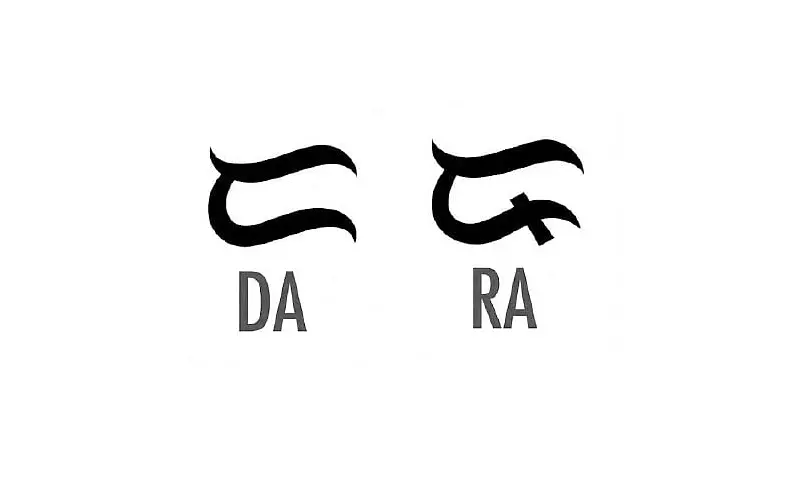
The modern Baybayin symbol for R now features a small tail at the bottom of the character, distinguishing it from the D symbol that lacks this feature.
Modern Linguistic Variations
Today, subtle differences in how Tagalog and Cebuano handle the D-R relationship reveal intriguing linguistic patterns. In Tagalog, initial D can become R when affixes are added, while in Cebuano, initial D typically remains unchanged.
Cebuano examples demonstrate this consistency: "dungog" (honor) becomes "kadungganan" or "madungganon," never transforming to R at the beginning. However, when D appears between vowels, as in "alidong" (circle) becoming "alirong," the transformation occurs naturally.
The rule doesn't apply when D appears between a vowel and consonant, as in "badbad" (untie), which becomes "badbaron" rather than "barbaron." Meanwhile, final D sounds frequently become R in affixed forms, as seen in "samad" becoming "samaran" or "buwad" transforming to "buwaran."
This enduring linguistic feature connects modern Filipino languages to their Austronesian ancestors through the living legacy of Baybayin and Badlit scripts, preserving ancient sound patterns in contemporary speech.