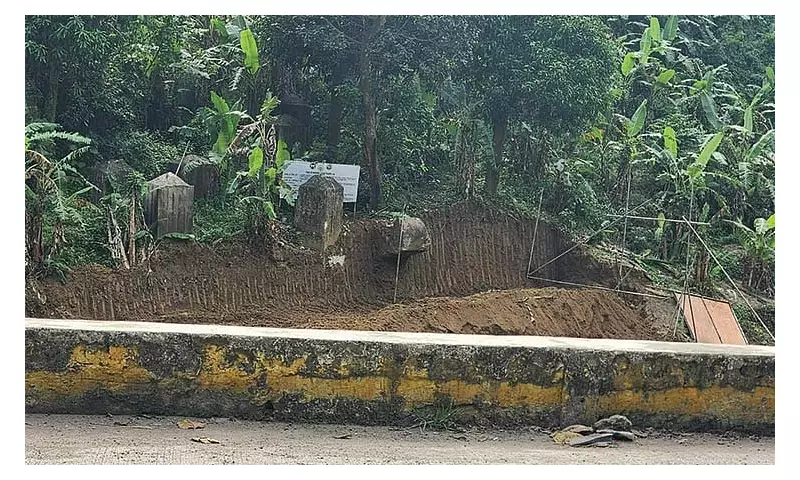
A critical flood control initiative in southern Cebu has sparked heritage conservation concerns as World War II historical structures face potential damage. The Department of Public Works and Highways (DPWH) project in Sitio Mainit, Barangay Pangan, City of Naga threatens to destroy iconic anti-tank barriers known as "dragon's teeth."
Heritage Law Violation Exposed
Cebu Province heritage consultant Jose Eleazar Reynes Bersales raised the alarm through social media on Friday, November 21, 2025. He revealed that the ongoing construction violates Republic Act 11961, the National Cultural Heritage Act, which mandates prior coordination with cultural agencies.
"I have just received reports that the World War II anti-tank barriers called 'dragon's teeth' in Sitio Mainit, Brgy. Pangan, City of Naga are in danger of destruction due to an on-going flood control project funded by the DPWH," Bersales stated in his Facebook post.

The law specifically requires government agencies to consult with the National Commission for Culture and the Arts (NCCA) and the National Historical Commission of the Philippines (NHCP) before implementing projects affecting cultural properties.
Ignorance No Excuse
In a concerning development, Bersales disclosed that a DPWH engineer claimed unawareness of the structures' significance during a message exchange on Saturday, November 22. The engineer promised compliance but admitted the agency had not conducted proper consultations.
"They didn't consult. They said they thought they weren't familiar with the structures. I told them, with something that big and that many, how could you not notice?" Bersales recounted to SunStar Cebu.
He emphasized the legal principle that "ignorance of the law excuses no one" regarding the violation of Section 36 of the law's implementing rules and regulations.
Currently in Japan for a six-month engagement, Bersales confirmed that both NCCA and NHCP plan to issue cease-and-desist orders to DPWH and the contractor. While initial reports indicate work has stopped in the affected area, verification of potential damage to the barriers remains pending.
Historical Significance of Dragon's Teeth
These concrete pyramids hold profound historical value for Cebu and the Philippines. According to Bersales' 2012 documentary Kabilin: The Fall of Cebu, the barriers were constructed by Cebuanos under United States Army Forces in the Far East (Usaffe) supervision before the April 1942 Japanese invasion.
The strategic placement in flatlands, riverbeds, and crossing points aimed to obstruct Japanese tank advances. During the war period, Cebu maintained only two primary east-to-west routes through Naga and Talisay-Toledo, both fortified by Usaffe to delay enemy progression and facilitate civilian evacuation.
The Barangay Sangi barriers in Toledo City were ultimately breached on April 10, 1942, merely one day after the Fall of Bataan, marking a significant moment in Philippine wartime history.
Pattern of Heritage Destruction
The threat to Cebu's WWII heritage extends beyond Naga. Bersales noted similar challenges in preserving anti-tank barriers across the province.
In Toledo City, most barriers and pillboxes remain intact, extending from behind City Hall to various barangays. Local authorities are negotiating land acquisition to ensure permanent preservation.
Talisay City, however, has suffered substantial losses. History researcher Marben Bascon from Talisay City College confirmed that many anti-tank barriers were destroyed during previous infrastructure projects.
"This was still intact right after the war, but when the widening of the Lagtang–Naga road began, some of the defense structures were destroyed. The same thing happened when the river was widened — the defense structures in the riverbed were removed and demolished," Bascon explained.
Historical records show:
- Approximately 80 original anti-tank barriers constructed against 1942 Japanese landing
- Only about 30 structures remain based on 2021 cultural mapping
- Destruction began in 1950s during road widening
- Further damage occurred during 2012-2013 Lagtang-Naga road and Mananga River works

Despite Talisay City Government recognizing the site as built heritage through a 2014 ordinance and NCCA-PReCUP inclusion, some damage became unavoidable during river widening since defenses were situated directly in riverbeds.
Provincial Conservation Precedent
The Cebu Provincial Government has established a strong track record of protecting heritage sites from infrastructure impacts. A significant precedent occurred in February 2024 when then-Governor Gwendolyn Garcia ordered immediate dismantling of Cebu Bus Rapid Transit station construction on Capitol property along Osmeña Boulevard.
Garcia's directive cited absent permits and potential Philippine Heritage Law violations, noting the structure would obstruct the historic Capitol building view. This intervention followed advice from Bersales, then serving as Capitol consultant on museums and heritage and NCCA Advisory Board member, who flagged the project's failure to secure NHCP authorization within a heritage zone.
The current situation in Naga represents another critical test for heritage conservation in Cebu, highlighting the ongoing tension between infrastructure development and historical preservation.