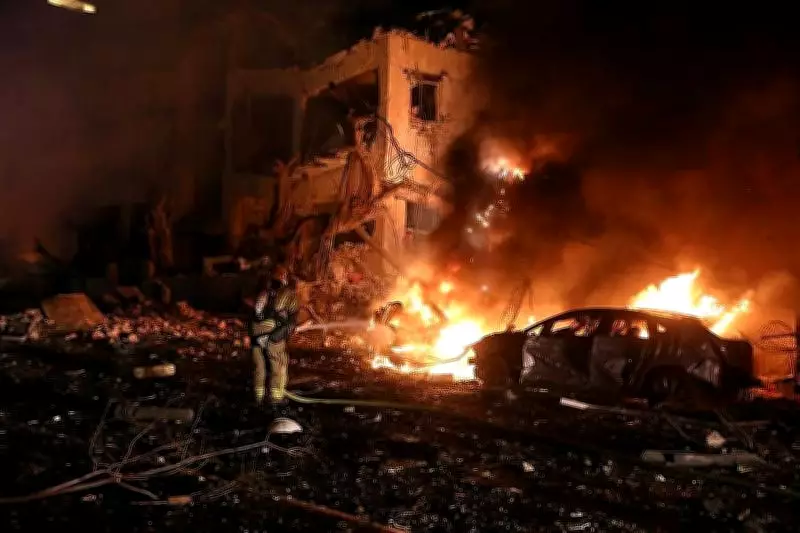
Iran's Supreme Leader Killed in Coordinated US-Israeli Military Operation
Iran's state media confirmed on Sunday, March 1, 2026, that Supreme Leader Ayatollah Ali Khamenei was killed in a joint United States and Israeli attack that took place the previous day. This devastating development has triggered immediate Iranian retaliation with missile strikes targeting both Israel and American assets throughout the Gulf region, marking a significant escalation in Middle Eastern tensions.
Unprecedented Military Action Unfolds Across Multiple Fronts
Israel initiated what it described as a "preemptive" strike on Saturday morning, deploying approximately two hundred fighter jets in simultaneous airstrikes against missile and defense systems located in western and central Iran. Shortly after this announcement, US President Donald Trump revealed on his Truth Social platform that American forces were "undertaking a massive and ongoing operation" specifically targeting Iran's missile industry infrastructure.
The Iranian response was swift and comprehensive. Iranian authorities declared all US military bases in the region as legitimate targets and launched strikes against both Israeli and American assets across multiple Gulf nations. Explosions were reported in Bahrain, Qatar, Kuwait, Jordan, the United Arab Emirates, and Saudi Arabia among other locations. The Islamic Revolution Guards Corps further announced the closure of the strategically vital Strait of Hormuz to shipping, declaring the crucial oil and gas waterway unsafe due to ongoing attacks.

Significant Casualties and Infrastructure Damage Reported
According to the Iranian Red Crescent Society, the initial strikes impacted at least twenty-four of Iran's thirty-one provinces, resulting in two hundred one confirmed deaths and seven hundred forty-seven injuries. Iranian Foreign Ministry spokesman Esmaeil Baghaei reported that up to one hundred sixty people may have been killed when airstrikes hit a school in southern Iran, with Iran's president condemning the incident as "inhumane." In Tehran, missiles struck near the offices of both the late Supreme Leader Khamenei and President Masoud Pezeshkian.
President Trump confirmed Khamenei's death in the strikes on Saturday, with Iranian state media providing official confirmation the following day. The Iranian government has subsequently announced a forty-day mourning period for their fallen leader.
Strategic Objectives and Timing of the Operation
In an eight-minute video statement, President Trump asserted that the operation's objective was "to defend the American people by eliminating imminent threats" originating from Iran. The Israeli Defense Ministry echoed this sentiment, stating their action aimed to "remove threats to Israel." However, analysts suggest the rhetoric indicates a broader strategic goal: facilitating governmental change in Iran through military force.
Syrian international relations researcher Mohammad Nader al-Omari noted that the timing was specifically chosen to maximize opportunities for eliminating top Iranian leadership while they were positioned at their command posts. Both the United States and Israel reportedly sought a swift, decisive outcome with minimal losses. The Pentagon has designated the operation "Operation Epic Fury," with US officials indicating it could continue for days or even weeks. Israeli media reports reveal planning had been underway for months, with the final execution date established weeks in advance.
Iran's Retaliatory Capabilities and Regional Implications
An unnamed Iranian official told Al Jazeera that there are now "no 'red lines' for Iran" following the US-Israeli strikes, suggesting that "anything is possible," including previously unconsidered scenarios. The official emphasized that Iran's response would be "full and open-ended, without time limits."

While the United States and Israel maintain significant military advantages, Iran retains potent retaliatory options, particularly through its substantial ballistic missile arsenal. Although the exact size remains unclear, Iran's ballistic missile capabilities are widely considered among the largest and most advanced in the Middle East, with certain missile types capable of reaching Israel in approximately twelve minutes.
Diplomatically, Iran has called upon the United Nations to take action against the strikes. Foreign Minister Seyed Abbas Araghchi, in letters to the UN secretary general and Security Council, reaffirmed Iran's right to self-defense while vowing to respond "decisively and immediately" until the aggression "completely and unconditionally stops."
Potential for Wider Regional Conflict and Global Economic Impact
Following the announcement of Khamenei's death, President Trump declared that "the heavy and pinpoint bombing, however, will continue, uninterrupted throughout the week or, as long as necessary to achieve our objective of peace throughout the Middle East and, indeed, the world!"
Analysts caution that what began as a calculated military action could spiral into an uncontrollable regional conflagration. Iraqi political analyst Adel al-Ghurairi observed that "the diplomatic track had already failed," adding that the strike represents "an admission that they believe the military option is the only remaining tool to roll back Iran's nuclear progress."
Palestinian political analyst Hussam al-Dajani warned that Gulf countries may face increasing pressure to choose sides, potentially "exacerbating existing rivalries or triggering new security dilemmas." Syrian researcher Mohammad Nader al-Omari noted the timing reflects domestic political considerations, with potential benefits for both President Trump ahead of US midterm congressional elections and Israeli Prime Minister Benjamin Netanyahu's political ambitions, creating additional incentives for escalation.
Economically, William Jackson, chief emerging markets economist at Capital Economics, warned that prolonged conflict could push Brent crude oil prices to one hundred US dollars per barrel, potentially adding up to zero point seven percentage points to global inflation. Iran's closure of the Strait of Hormuz, which handles twenty percent of global oil shipments, risks immediate supply disruptions, while the Organization of the Petroleum Exporting Countries and its allies may face mounting pressure to increase production to stabilize markets.