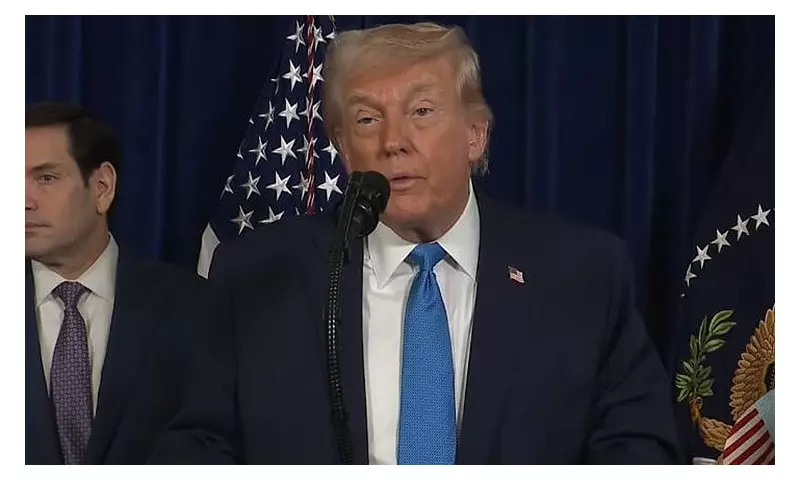
In a dramatic escalation of foreign intervention, the United States has launched a military operation in Venezuela, resulting in the capture of the country's leader, Nicolás Maduro, and his wife. President Donald Trump announced the action from his Mar-a-Lago estate in Palm Beach, Florida, on Sunday, January 4, 2026, declaring that America now intends to "run the country" during a transitional period.
U.S. Assumes Control of Venezuela
During a press conference, President Trump detailed the operation, stating that American forces had successfully rounded up a strong military fortress in the heart of Caracas to apprehend Maduro. The captured leader and his spouse are reportedly being transported to New York. Trump framed the intervention as a necessary step to ensure stability, vowing that the U.S. would manage Venezuela "until such time as we can do a safe, proper and judicious transition."
He explicitly ruled out allowing other actors to take power, citing a desire to avoid a repeat of past instability. While no specific timeline for the transition of power was provided, Trump named key officials, including Secretary of State Marco Rubio and Defense Secretary Pete Hegseth, to work with a group in managing Venezuela's affairs.

Military Presence and Oil Ambitions
The U.S. military footprint in the region remains significant and ready. Chairman of the Joint Chiefs of Staff, Dan Caine, confirmed that American troops "remain in the region at a high state of readiness" following the major attacks and Maduro's capture. When questioned about the ongoing military presence, Trump linked it directly to Venezuela's oil resources, stating, "We're going to have a presence in Venezuela as it pertains to oil."
He outlined plans to authorize major American oil companies to manage and invest in Venezuela's energy infrastructure. Crucially, Trump emphasized that the embargo on all Venezuelan oil remains in full effect. He stated that wealth extracted from Venezuelan soil would go to its people, former residents, and also to the United States as "reimbursement for the damages caused us by that country."
Global Backlash and a Revived Doctrine
The military action has triggered immediate condemnation and concern worldwide. The Venezuelan government denounced the "military aggression", claiming the attacks targeted civilian and military sites in at least four states. United Nations Secretary-General Antonio Guterres expressed deep concern, with his spokesperson stressing the importance of respecting international law and the UN Charter.
Domestically within the U.S., protests under the banner "No War on Venezuela" are planned in cities including Washington, D.C., Chicago, and New York. Organizers like the Answer Coalition warn against another endless war that would bring death and destruction to Venezuelans.
President Trump framed the entire operation as a reinstatement of American hemispheric policy, claiming his administration has "replaced" the Monroe Doctrine, a 19th-century principle asserting U.S. influence in the Americas. The situation leaves Venezuela under de facto U.S. administration, with its future governance and the fate of its captured president hanging in the balance.