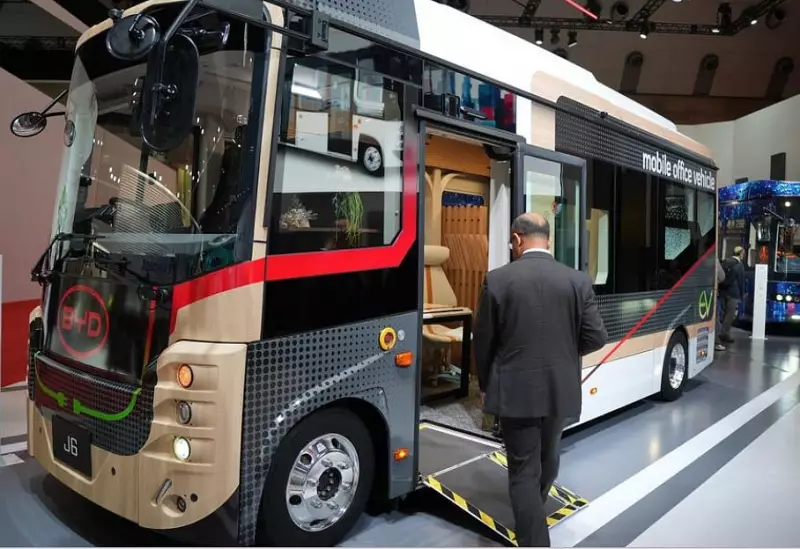
Japanese drivers are about to get more electric options as Chinese automakers make a significant push into the country's automotive market. The recent 2025 Japan Mobility Show in Tokyo became the stage for this new competition, where China's leading electric vehicle manufacturers unveiled more than a dozen new energy vehicle models.
BYD's Strategic Market Entry
Leading the charge was Chinese carmaker BYD, which made a substantial impact by showcasing 13 different models at the October event. Their display included the compact all-electric Sealion Mini EV, specifically designed for Japan's lightweight car segment, along with the plug-in hybrid Sealion 06DM-i and the all-electric SUV ATTO 3.
The company also introduced two commercial vehicles making their global debut: the T35 small electric truck and the K8 large electric bus. However, it's the Sealion Mini that's causing the biggest stir in industry circles by directly challenging a market segment long dominated by Japanese manufacturers.

According to Tang Jin, a senior researcher at Mizuho Bank, BYD's new model targets Japan's massive compact car segment of approximately 1.7 million units annually. This segment represents the mainstream and core pillar of Japan's passenger car market.
Competitive Advantages and Market Response
The upcoming Sealion Mini, scheduled for release in 2026, promises to shake up the market with impressive specifications. Tang predicts the vehicle will offer a driving range exceeding 300 kilometers, roughly double that of Nissan's popular Sakura model, while being priced 20 to 30 percent lower than comparable Japanese models.
This competitive pricing and extended range could prove highly attractive to Japanese consumers, who have traditionally shown strong loyalty to domestic brands. The entry of Chinese manufacturers comes at a crucial time, as experts believe it could accelerate Japan's slow transition toward vehicle electrification.
The influence of China's NEV expansion was clearly visible among Japanese exhibitors at the show. Honda responded by introducing six new electric models, including the N-ONE e: aimed at the compact car market. Nissan showcased a solar panel-equipped version of their Sakura to boost range, while Suzuki presented its Vision e-Sky, a compact EV scheduled for launch in fiscal 2026.
Infrastructure Expansion and Future Prospects
Suzuki president Toshihiro Suzuki acknowledged that BYD's entry into the compact EV segment would act as a catalyst for the popularization of small electric cars in Japan. He confirmed his company would continue advancing its own EV development and rollout plans in response to the new competition.
Since entering Japan's passenger car market in early 2023, BYD has drawn considerable attention from the Japanese automotive industry. The company faces two significant hurdles: strong consumer preference for domestic brands and the continuing dominance of gasoline vehicles.
The market numbers highlight the challenge and opportunity. In 2024, battery-electric and plug-in hybrid vehicles accounted for only 2.6 percent of new car sales in Japan, with expectations for a modest increase to 3.5-3.6 percent in 2025.
BYD Japan is adapting its approach to local market conditions. Responding to strong demand for compact and hybrid vehicles, the company plans to introduce more plug-in hybrid and lightweight EV models specifically for Japanese consumers.
The automaker has already established a growing presence with over 60 dealerships across Japan as of October and aims to exceed 80 by year-end. They're also expanding fast-charging infrastructure compatible with existing Japanese networks to improve customer convenience.
Meanwhile, Geely's premium EV brand Zeekr is reportedly preparing to enter the Japanese market through local distribution partners, signaling further Chinese competition ahead.
Tang emphasized the potential for collaboration between Chinese and Japanese companies in materials, components, and advanced manufacturing. As Chinese electric vehicles expand globally, technological and capital cooperation between the two countries could create mutual benefits and genuine win-win scenarios in the evolving automotive landscape.